







Agency
Fluencify Is Selling Brands Guaranteed Views From Everyday Consumers on Fresh Accounts
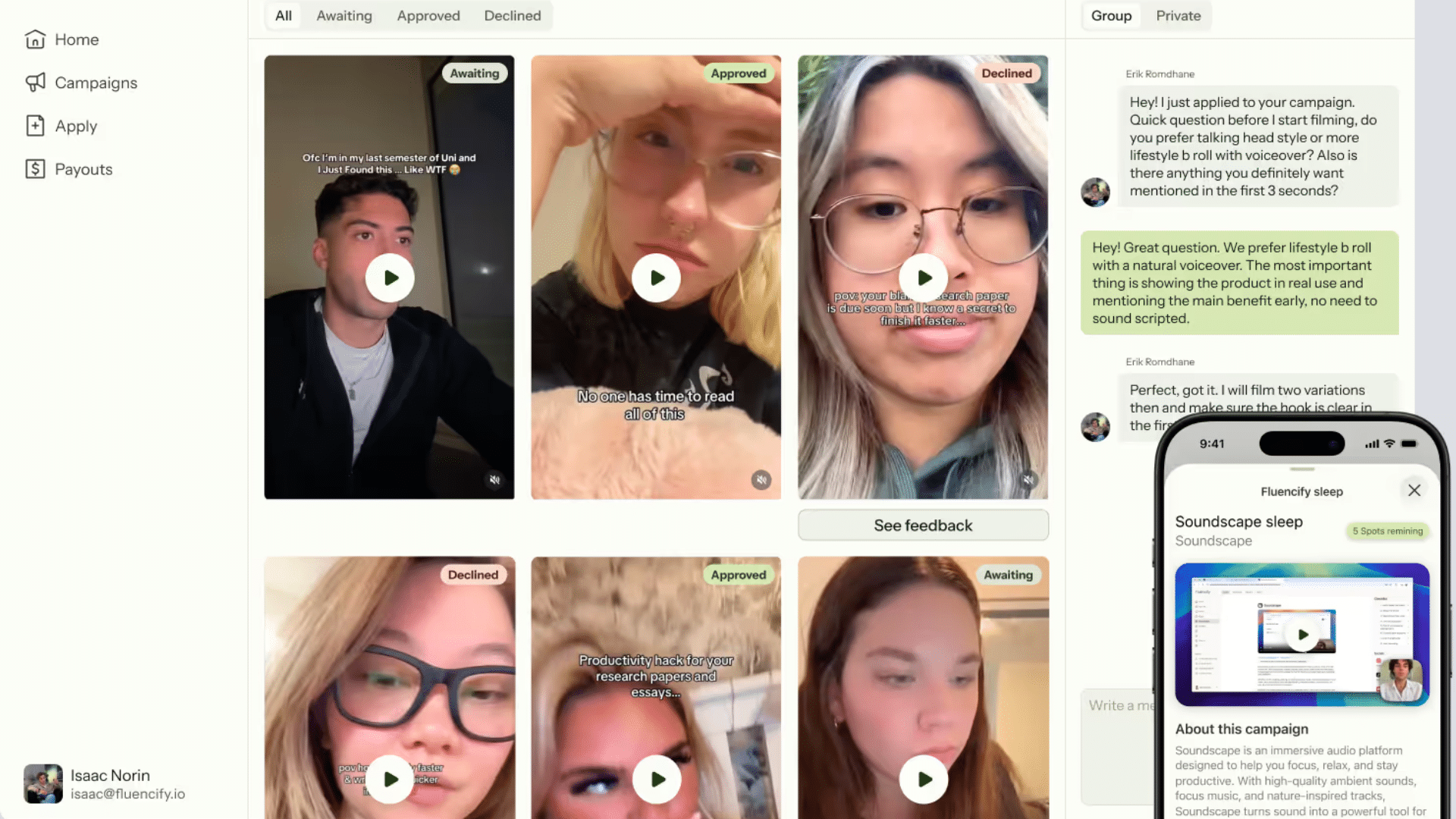
Fluencify sells consumer brands a guaranteed number of views on short-form video. The Stockholm-based startup trains everyday people who already like a product to make that video, then posts it from brand-new Instagram and TikTok accounts with no audience behind them. Co-founder Erik Romdhane is betting that platform algorithms now decide reach based on the video itself, which makes follower count matter less.
An audience is something Erik has built himself. In high school, he grew a study-motivation page to around 1 million followers across Instagram and TikTok, then co-founded BrandPlant, a management agency for creators with 1 million to 3 million followers, which he exited in January 2024. Running that roster raised the question his current company now answers. “We realized, ‘Why can’t we just go and find actual consumers and train them to create content?’” Erik says.
That idea took shape in November 2025. The company recruits consumers who love a product and turns them into what Erik calls “a content army for brands,” producing video at volume for consumer brands that spend at least $5,000 a month. B2B companies chasing high-ticket clients fall outside the model for now, though Erik says a B2B offering is on the roadmap for the coming months. The company is backed by a $4.3 million pre-seed round led by byFounders, with Wave Ventures participating.
The model also reflects how Erik ran campaigns before. At BrandPlant, he says, the work meant a spreadsheet, hand-sourced emails, and watching every video. Fluencify hands those steps to software agents. “I believe the agency model is a bit outdated,” Erik says. What brands buy is a set number of views.
Views Are the Metric Fluencify Can Guarantee
Fluencify prices views because, in Erik’s experience, revenue and installs from organic video are hard to trace. Viewers who see a product in a viral video rarely click a link or scan a QR code. “It’s mostly that they see the product, search it up,” he says. “That’s where we stuck with views, because it’s tangible in a way that other metrics aren’t.”
The step from views to sales runs through people. Fluencify works with the brand’s Influencer Marketing manager or founder, who watches installs and revenue day to day. Erik offers the case of a video that hits 10 million views. “If they don’t see any uptick in installs or in revenue, that is a clear sign it’s not working,” he says. The brand flags it, and Fluencify changes the campaign and its format.
The guarantee covers reach. Whether that reach turns into sales is judged by the brand’s own numbers and the person who owns them. “I think it’s based a lot on our personal contact on the brand side,” Erik says.
The objection brands raise most often sits earlier in the chain. According to Erik, they doubt the content will reach views at all, a concern Fluencify answers with the guarantee and its per-view pricing. That doubt is about who is posting.
Algorithms Now Rank the Video Over the Account
Those posters are mostly people with no audience, and Erik’s explanation for why that works is technical. In his telling, Meta and TikTok once leaned on follower count because it was easy to show content to people who followed a page. Now they judge the hook, the body and the call to action, then serve the video to users who have never seen the account.
“As long as you create valuable content, whether that is emotional value or practical value, it will reach the right viewer,” Erik says.
Fluencify pushes that logic further by opening a new account for every creator, so the algorithm learns the creator’s niche from the first post. Erik’s example is a five-year-old account that has posted about beauty and then pivots to studying. “The algorithm recognizes that this is a beauty account,” he says. A switch to study content muddles that signal and costs reach.
A new account has no followers to fall back on. Reach has to come from the content, and from how much of it gets made.
Soundscape Shows How Much Volume the Model Needs
Soundscape, an app Fluencify has worked with for a year, receives thousands of videos a month from the company, according to Erik. Its campaign produced the one acquisition cost he could calculate cleanly.
Soundscape paused all other marketing so that Fluencify was its only channel for a period Erik describes as a month. That let the two sides set installs against creator spend. The result, he says, was a customer acquisition cost of seven U.S. cents across Western Europe, the UK and Canada.
Getting there took around 2,000 videos, and Fluencify hit the views it had guaranteed. “We see it more as a volume game when you need to reach those small customer acquisition costs,” Erik says.
The clean number comes with a condition Erik states himself. Larger brands run multiple marketing budgets across multiple verticals, so Fluencify cannot isolate its contribution the same way. In his account, that volume was also steered by what viewers responded to.
Comment Sections Decide Which Videos Get Copied
At Soundscape, the team concentrated on the study niche and built what Erik calls “guerrilla formats,” videos designed to provoke a feeling in the first three seconds, often through a visible mistake. In one, a creator recording the app spills coffee over a stack of papers.
The comments show whether the moment landed. If viewers mention the coffee, the team reproduces the beat with multiple creators across its roster. Erik says comments get classified by whether viewers are reacting to an object, a feeling, or the product itself. “Comments are very underrated in tracking how the video actually goes and what people actually react to,” he says.
Erik expected that playbook to hit a limit with a client in accounting software, and Fluencify told the company up front it doubted bookkeeping could go viral. “It’s commonly known as a boring thing that cannot be engineered for virality,” Erik says. The team took concepts from the corporate world, tailored them to accounting, and got videos to go viral, a result he says surprised him.
Both cases depend on Fluencify deciding, video by video, what to repeat. That control is the first thing it asks clients to give up.
Brands Hand Fluencify the Day-to-Day Campaign
“We should run the campaigns and not the brands,” Erik says. Clients bring pointers and requirements, and Fluencify runs the daily work, which he describes as the real commitment a brand makes in its first 60 days. The other commitment is budget, since Fluencify takes only clients spending $5,000 a month or more.
What brands get back is time. A brand running its own creator program can hand those creators over, and Fluencify takes on the messaging and negotiation. In Erik’s account, that leaves the brand’s team more time for the company’s overall creative direction.
He applies the same arithmetic to agencies. “If you are working 90% of your time messaging creators back and forth, you only have 10% of time to actually think about the creative concepts,” Erik says. Traditional agencies that keep that work manual, he argues, will have a very difficult time unless they change quickly.
His prescription is to automate the small tasks so people can focus on creative direction and on outcomes. Outcomes are also where he expects the buying model to move.
Erik Expects Creator Budgets to Work Like Ad Budgets
In five years, Erik expects buying creator content to resemble buying Meta or TikTok ads. A brand would commit a budget ($20,000 a month in his example) and get performance back, whether measured in views, installs or revenue, with people and agents working together behind it. He expects the market to track outcomes more than inputs, though he hedges. “The Creator Economy as a whole is very irrational, so it can go any direction,” Erik says.
Fluencify’s views guarantee is an early version of that arrangement, priced on the outcome the company can count while installs and revenue stay with the brand’s own tracking.
Erik wants Fluencify underneath that market. “We want to be the infrastructure it runs on,” he adds. “We want to be the operating system for the Creator Economy.”
Subscribe to Our Newsletter
Check Out Our Podcast