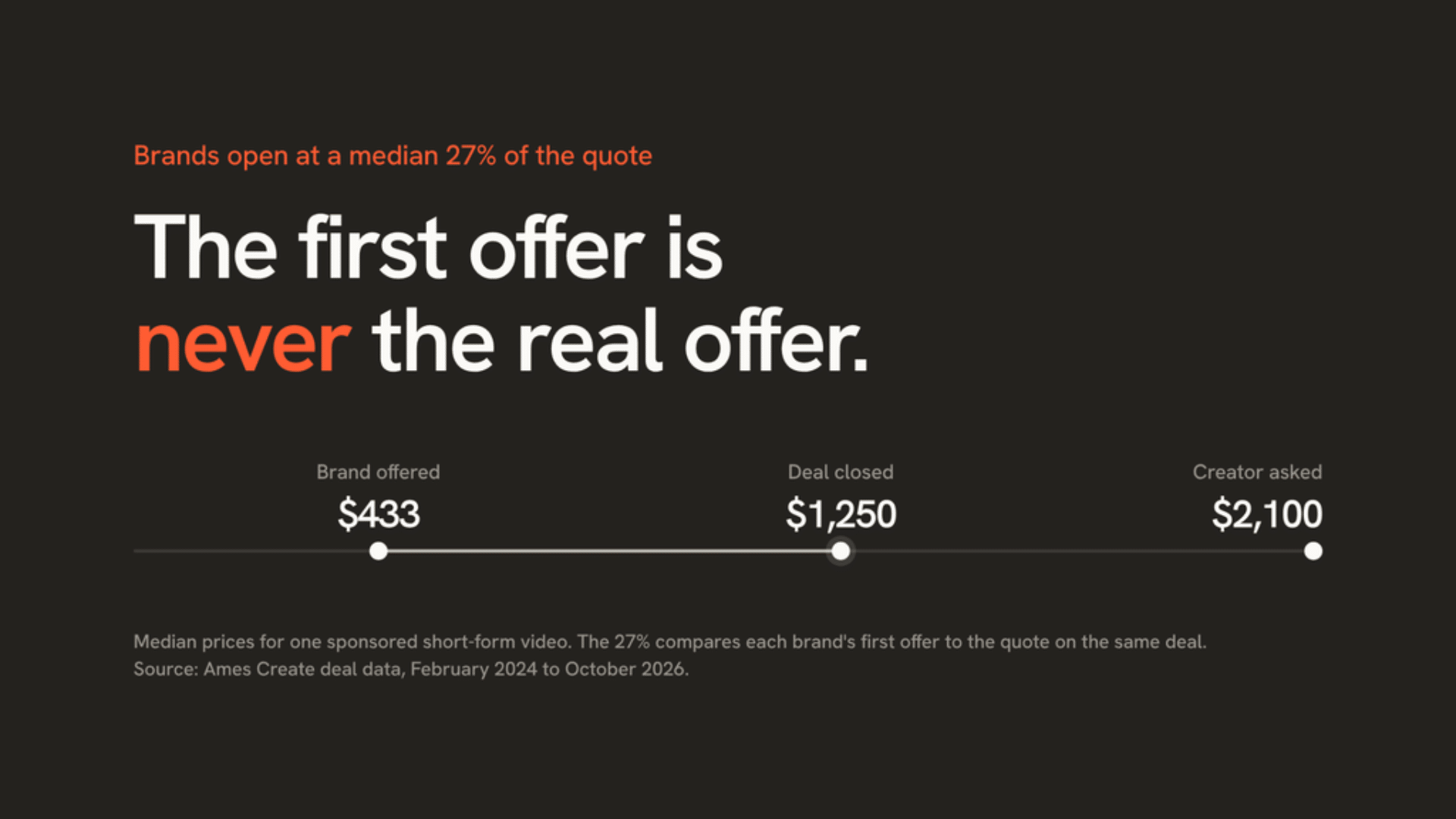
A creator sponsorship rarely closes at the brand’s first offer, and the final price depends on how well the creator can back up the ask. In deal data from Ames Create, a brand’s first offer ran a median 27% of the quoted price. Founder Brandon Ames, who posted the figures publicly, is also steering the creators on his roster toward products and communities they own, so one-off sponsorships make up less of their income.
That data comes from the deal log of Ames Create, the Indianapolis studio Brandon started in 2021, and covers 124 brand deal conversations between February 2024 and October 2026. “We put the numbers out in hopes that this would bring the floor up for creator deals and raise the price,” Brandon says. “The goal is just to be transparent and then be an authority in the space,” he adds.
Brandon casts both aims as pro-creator. “I’m definitely working more for the creator,” he says, though on long-term deals the work also turns toward keeping the brand happy, because a creator wants to keep the deal going. On the brand side, the studio builds ads into a creator’s content, an approach Brandon says MrBeast inspired. “Every brand really does want the organic feeling, to not be forced into the content,” he says.
That brand work is still the base of the business. “We still do the bread and butter of brand deals and the traditional stuff,” says Brandon, whose roster of 16 creators runs from small channels to ones with millions of subscribers.
Counteroffers Change Scope to Hold the Price
Ten closed sponsorship deals landed between $250 and $4,000 per video, with $1,250 in the middle. Ames Create negotiates offers up through added deliverables that cost the creator little extra work, Brandon says. “A story is really just free value from the creator’s perspective,” he says.
In his example, a brand offers $1,000 for one video from a creator whose budget typically runs $2,000 to $2,500. Ames Create counters with one video and four stories, which he says makes $2,000 easier for the brand to accept. When a brand’s budget falls, the studio cuts deliverables and leaves the price alone. “One thing we do that is pro creator is we’ll never reduce their value,” Brandon says.
Each counter rests on a number the buyer can defend internally. Ames Create opens with a figure it can back with CPMs and answers a low offer with a rate it describes as industry standard. “We like to give ad people something they can go back to their boss and say, this has a $7 CPM,” Brandon says. When a brand wants to use the content itself, the studio adds 30% to 40% for paid usage.
Average Views Set the Price
Average views are the other number Ames Create uses to back that figure. “Hardly anybody is talking about followers anymore,” Brandon says. “It’s really just average views.” Reach also explains the spread across those closed deals, he says.
Rate guides from Modash and Karat put a sponsored Instagram Reel at about $15 to $35 per 1,000 views, according to Ames Create’s page. Across three brands that priced views themselves, the figure was $7 to $10. On three measured campaigns, the videos beat the views the fees assumed, which lowered what brands paid to $1.55 to $4.72 per 1,000 views delivered. “Seven to 10 is definitely the most common range we’re quoted, if not lower than that,” Brandon says.
Brand reps watch average views too. When they flatten, the rep tends to call, Brandon says. “If you as a creator are feeling a plateau, your brand deals are definitely feeling it too.”
Performance Gives Creators Leverage
Brands weigh platform numbers again when they decide to sign. “You really can’t turn something into nothing just on the email,” Brandon says, adding that there is no better time to close than when several videos are taking off.
Unpaid work also feeds the negotiations. Ames Create features brands it wants to land in its creators’ videos and shows the posts to those brands as case studies, Brandon says. The DoorDash x Nike Tech stunt with creator Young Mantis earned nothing from either company, he says, but it landed while the studio was renegotiating some of the longer-term deals. “We ended up using the hype of that to re-sign a few of our longer-term deals with our partners,” he says.
A viral stunt also raises what brands expect. “It does sort of create a vicious treadmill to where the brand will be like, we want more,” Brandon says, though some partners understand a spike will not repeat.
Bonus clauses give creators a stake in outliers. A creator’s first long-term deal usually has none, Brandon says, but at renewal the studio can often add one, such as an extra payout if the content reaches 25 million views in six months. Brands can be nervous about them, he says, and grow less keen once they see them work.
Longer Deals Win Over Higher Offers
A few years ago, Ames Create turned down an offer 20% to 30% higher than the one it signed, Brandon says, because the other brand had a larger social presence and could amplify the creator through its own network. He says the paid amplification outweighed the difference.
The test is whether a brand has a world for the creator to plug into. “If they have a whole creative world for us to plug into, then that’s someone we see as a longer-term partner,” Brandon says. TickPick signed one of the studio’s creators to a 12-month deal after a single video, he says, then renewed for two more, with Ames Create building the creative and deal structure across all three.
Ten multi-month campaigns in the deal data closed at $2,667 to $15,000 a month, with $6,750 in the middle. A brand pays less per video for committing, while the creator gets income to plan around.
Brandon contrasts that approach with the wider agency model. “I think most agency business models are focused on just capturing the massive six-figure brand deal budgets and then spray and praying them,” he says. He describes brands that spread a $50,000 budget across 25 creators in one month, and says he would work with five creators for six months instead.
Products Start Where Audiences Already Pay
The studio also builds products for creators’ own communities. Slot Check, an AI slot machine scanner, grew out of a paid Discord group of about 4,000 people built around Vegas tips. Ames Create partnered with the creator last year and tested interest with a newsletter before building the app. Brandon says it has 2,568 users less than two months in.
“Some of the most successful creators are the ones with a paid community or a really active audience,” Brandon says. Sponsor concentration gives the studio another reason to build. Gambling is controversial, he says, but it is a pillar category, and for male creators and audiences “there really are just a few big brand players and that’s, kind of, what’s left of it.”
Audience cultivation sits near the top of the studio’s priorities, Brandon says. “We’ll usually turn down brand deals we think might ick our audience.”
The Ten-Year Hope Is Creator-Owned Businesses
On the advertiser side, Ames Create is building plastr, a marketplace for physical ads that Brandon positions against billboards. “You’re paying for eyeballs that you don’t know exactly whose eyeballs they are,” he says of the billboard model. Any brand or creator can advertise across the backdrops listed there, and he says the studio is not worried about losing business to it. “We literally built a platform to cut ourselves out,” he says.
Brandon’s ten-year hope is that creators get paid by businesses they own, and he points to community-based brands such as run clubs and paid groups as an early version. Ames Create is already building a few brands around creator communities, he says.
“I would like to see in ten years micro creators have coffee shops in their city that they own and that’s their business,” he says.
Cecilia Carloni, Interview Manager at Influence Weekly and writer for NetInfluencer. Coming from beautiful Argentina, Ceci has spent years chatting with big names in the influencer world, making friends and learning insider info along the way. When she’s not deep in interviews or writing, she's enjoying life with her two daughters. Ceci’s stories give a peek behind the curtain of influencer life, sharing the real and interesting tales from her many conversations with movers and shakers in the space.










A creator sponsorship rarely closes at the brand’s first offer, and the final price depends on how well the creator can back up the ask. In deal data from Ames Create, a brand’s first offer ran a median 27% of the quoted price. Founder Brandon Ames, who posted the figures publicly, is also steering the creators on his roster toward products and communities they own, so one-off sponsorships make up less of their income.
That data comes from the deal log of Ames Create, the Indianapolis studio Brandon started in 2021, and covers 124 brand deal conversations between February 2024 and October 2026. “We put the numbers out in hopes that this would bring the floor up for creator deals and raise the price,” Brandon says. “The goal is just to be transparent and then be an authority in the space,” he adds.
Brandon casts both aims as pro-creator. “I’m definitely working more for the creator,” he says, though on long-term deals the work also turns toward keeping the brand happy, because a creator wants to keep the deal going. On the brand side, the studio builds ads into a creator’s content, an approach Brandon says MrBeast inspired. “Every brand really does want the organic feeling, to not be forced into the content,” he says.
That brand work is still the base of the business. “We still do the bread and butter of brand deals and the traditional stuff,” says Brandon, whose roster of 16 creators runs from small channels to ones with millions of subscribers.
Counteroffers Change Scope to Hold the Price
Ten closed sponsorship deals landed between $250 and $4,000 per video, with $1,250 in the middle. Ames Create negotiates offers up through added deliverables that cost the creator little extra work, Brandon says. “A story is really just free value from the creator’s perspective,” he says.
In his example, a brand offers $1,000 for one video from a creator whose budget typically runs $2,000 to $2,500. Ames Create counters with one video and four stories, which he says makes $2,000 easier for the brand to accept. When a brand’s budget falls, the studio cuts deliverables and leaves the price alone. “One thing we do that is pro creator is we’ll never reduce their value,” Brandon says.
Each counter rests on a number the buyer can defend internally. Ames Create opens with a figure it can back with CPMs and answers a low offer with a rate it describes as industry standard. “We like to give ad people something they can go back to their boss and say, this has a $7 CPM,” Brandon says. When a brand wants to use the content itself, the studio adds 30% to 40% for paid usage.
Average Views Set the Price
Average views are the other number Ames Create uses to back that figure. “Hardly anybody is talking about followers anymore,” Brandon says. “It’s really just average views.” Reach also explains the spread across those closed deals, he says.
Rate guides from Modash and Karat put a sponsored Instagram Reel at about $15 to $35 per 1,000 views, according to Ames Create’s page. Across three brands that priced views themselves, the figure was $7 to $10. On three measured campaigns, the videos beat the views the fees assumed, which lowered what brands paid to $1.55 to $4.72 per 1,000 views delivered. “Seven to 10 is definitely the most common range we’re quoted, if not lower than that,” Brandon says.
Brand reps watch average views too. When they flatten, the rep tends to call, Brandon says. “If you as a creator are feeling a plateau, your brand deals are definitely feeling it too.”
Performance Gives Creators Leverage
Brands weigh platform numbers again when they decide to sign. “You really can’t turn something into nothing just on the email,” Brandon says, adding that there is no better time to close than when several videos are taking off.
Unpaid work also feeds the negotiations. Ames Create features brands it wants to land in its creators’ videos and shows the posts to those brands as case studies, Brandon says. The DoorDash x Nike Tech stunt with creator Young Mantis earned nothing from either company, he says, but it landed while the studio was renegotiating some of the longer-term deals. “We ended up using the hype of that to re-sign a few of our longer-term deals with our partners,” he says.
A viral stunt also raises what brands expect. “It does sort of create a vicious treadmill to where the brand will be like, we want more,” Brandon says, though some partners understand a spike will not repeat.
Bonus clauses give creators a stake in outliers. A creator’s first long-term deal usually has none, Brandon says, but at renewal the studio can often add one, such as an extra payout if the content reaches 25 million views in six months. Brands can be nervous about them, he says, and grow less keen once they see them work.
Longer Deals Win Over Higher Offers
A few years ago, Ames Create turned down an offer 20% to 30% higher than the one it signed, Brandon says, because the other brand had a larger social presence and could amplify the creator through its own network. He says the paid amplification outweighed the difference.
The test is whether a brand has a world for the creator to plug into. “If they have a whole creative world for us to plug into, then that’s someone we see as a longer-term partner,” Brandon says. TickPick signed one of the studio’s creators to a 12-month deal after a single video, he says, then renewed for two more, with Ames Create building the creative and deal structure across all three.
Ten multi-month campaigns in the deal data closed at $2,667 to $15,000 a month, with $6,750 in the middle. A brand pays less per video for committing, while the creator gets income to plan around.
Brandon contrasts that approach with the wider agency model. “I think most agency business models are focused on just capturing the massive six-figure brand deal budgets and then spray and praying them,” he says. He describes brands that spread a $50,000 budget across 25 creators in one month, and says he would work with five creators for six months instead.
Products Start Where Audiences Already Pay
The studio also builds products for creators’ own communities. Slot Check, an AI slot machine scanner, grew out of a paid Discord group of about 4,000 people built around Vegas tips. Ames Create partnered with the creator last year and tested interest with a newsletter before building the app. Brandon says it has 2,568 users less than two months in.
“Some of the most successful creators are the ones with a paid community or a really active audience,” Brandon says. Sponsor concentration gives the studio another reason to build. Gambling is controversial, he says, but it is a pillar category, and for male creators and audiences “there really are just a few big brand players and that’s, kind of, what’s left of it.”
Audience cultivation sits near the top of the studio’s priorities, Brandon says. “We’ll usually turn down brand deals we think might ick our audience.”
The Ten-Year Hope Is Creator-Owned Businesses
On the advertiser side, Ames Create is building plastr, a marketplace for physical ads that Brandon positions against billboards. “You’re paying for eyeballs that you don’t know exactly whose eyeballs they are,” he says of the billboard model. Any brand or creator can advertise across the backdrops listed there, and he says the studio is not worried about losing business to it. “We literally built a platform to cut ourselves out,” he says.
Brandon’s ten-year hope is that creators get paid by businesses they own, and he points to community-based brands such as run clubs and paid groups as an early version. Ames Create is already building a few brands around creator communities, he says.
“I would like to see in ten years micro creators have coffee shops in their city that they own and that’s their business,” he says.
Subscribe to Our Newsletter
Check Out Our Podcast