Influencer
Clipping 101: Inside the Clipping Economy

You have probably heard of the concept of clipping. You have definitely seen it. A podcast moment cut to thirty seconds and posted by an account with a generic name and no bio, or the same movie scene showing up from four different pages in one afternoon.
These short video clips have proliferated across every social media platform, from TikTok to Instagram to LinkedIn, blending into the fabric of the feed, with most watchers paying little attention to where the content came from or why it is there. But behind many of them is an ecosystem and an incentive model that produces these clips at scale for reach and engagement.
A brand posting to its own account gets one shot at the algorithm. A clipping network gets thousands, from thousands of accounts, and the brand only pays for the ones that land. Welcome to the world of clipping.
Companies from record labels to movie studios to streamers have already embraced the concept, leveraging their deep content catalogs to reach audiences that would never visit their own channels. We spoke with the founders of six clipping agencies to find out how the business works, where the money goes, and whether the model can be extended to the consumer brands that make up the core of the creator economy.
The brand pays after, and only for views that clear a floor
A clipping campaign begins with a brief. The brand tells the agency which platforms it wants, who should be tagged, and what the clips can and cannot say. The agency turns that into a one-page requirement sheet for the clippers. The brand then sets two numbers: a total budget, and a rate for every thousand views a clip earns.
The brand decides how far the campaign reaches. Some are open to the agency’s entire network. Some require clippers to apply, and the brand approves each account. On longer contracts, agencies build pages for a single brand and staff them with clippers on retainer.
Then the campaign goes live. Thousands of clippers receive a notification. They download the footage, cut a clip, post it to their own page, and submit the link. Within a day, hundreds of versions of the same footage are in circulation, posted by people the brand has never met.
No one is paid until a post clears a threshold, typically somewhere between one thousand and ten thousand views depending on the agency. Every post that clears it is reviewed by a person. A post that violates the requirement sheet is rejected and never paid. When the budget is spent, the campaign ends. The brand receives a report. The clippers are paid.
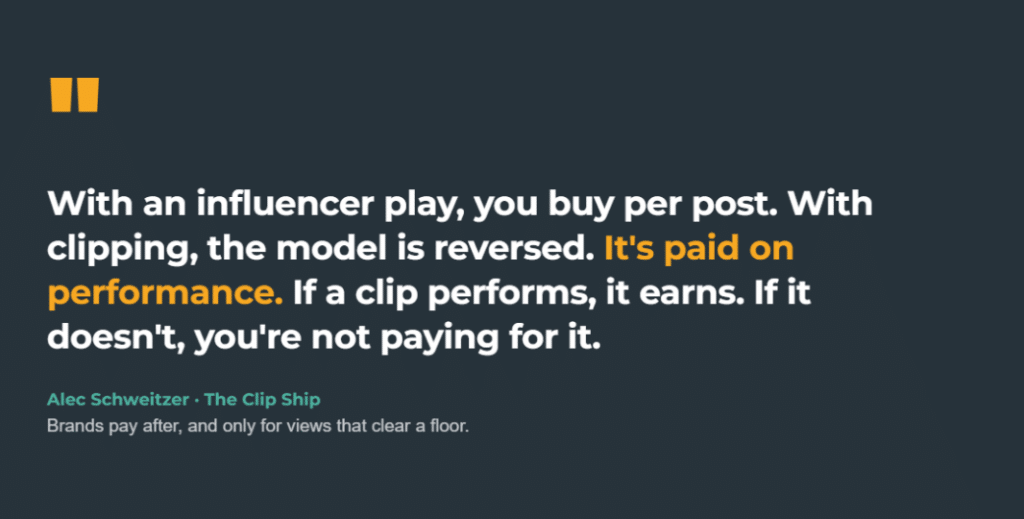
Budgets are small by the standards of a media buy. Most campaigns run from a few thousand dollars to the low tens of thousands. How much of the budget reaches the clippers varies by agency, and the split is rarely shown to the client. The universal across all campaigns is that clipping is performance based. Brands only pay for views that were delivered and verified.
From Meme Pages to Paid Placements
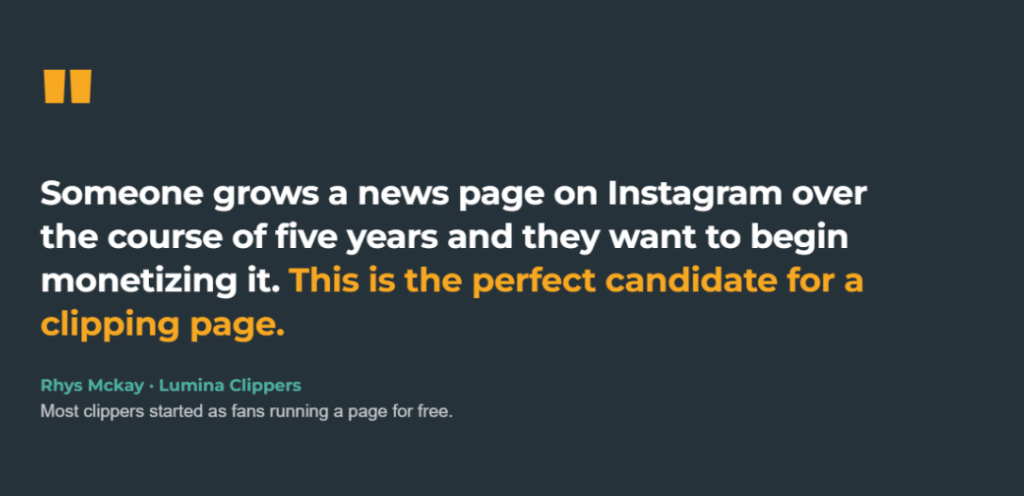
Most clippers started as fans running a page for free, a meme account, an athlete fan page, a celebrity news feed, and until recently the only way to earn from one was to message brands and ask for a promo fee. Clipping gives the same people, who already know what their corner of the internet will watch, a way to get paid for that instinct.
Nearly all of them do this on the side. The agency founders we spoke with describe high school students, college students, and parents with day jobs. Most run one or two pages. A small number run dozens.
The pages and accounts remain the property of the people who built them. Most earn little from them. A few earn a great deal. Turan Selvi of Clipster described one. “We had one creator that came to us that was posting movie edits for free, making hundreds of thousands of views, and he had no clue that there’s actually labels paying for it. He went from making nothing to making $9,000 in his first month. We have over 20 creators that make consistently over $10,000 per month, and on the very top end, the record month was $60,000.” He added a caveat. “The clippers that make the most money have pre-existing channels, networks, content that they already post. I don’t think clipping is a thing where someone just sits on their couch, sees an ad, downloads TikTok, creates an account, and suddenly they make $10,000 next month.”
The few clips that work become the ad campaign
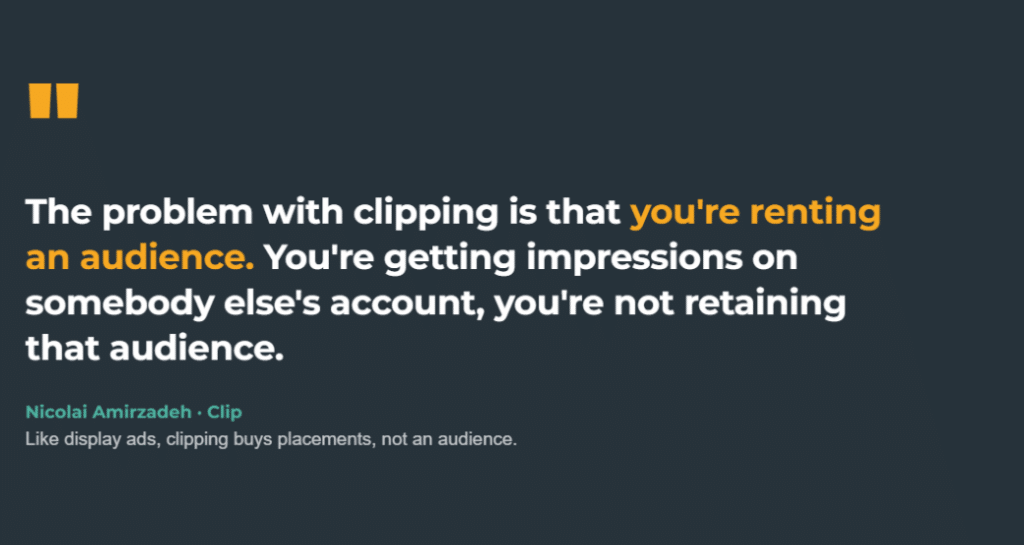
A brand that runs a clipping campaign gets two things back. The first is the views themselves, spread across pages the brand does not own. The count cannot show whether the people watching were new to the brand or had seen it four times already, because the platforms do not release that data. The founders’ case is that a brand is paid attention to by being seen repeatedly, and that clipping is bought for repetition as much as for reach.
The second is a creative test. Out of thousands of posts, a few dozen work, and those get run again as paid ads, from the brand’s own account or, through boost and partner codes, directly from the clipper’s page, where they perform because they do not read as ads. Alec Schweitzer of The Clip Ship describes clipping as a test bed for paid creative, thousands of variations run for the price of the views, with the best few promoted, and calls the result “paid social 2.0,” then in the same breath “technically paid social.”
Amirzadeh, takes it a step further. Clip finds the clippers whose pages worked and hires them on retainer to run pages the brand owns. For the clipper it is an hour or two a day at a steady rate. For the brand it is an audience it gets to keep. Clip’s entertainment clients get one more thing. For the studios and production companies it clips shows for, Clip pulls the comments from every post and maps which scenes drew the most attention, because Netflix, Hulu, Peacock and Tubi do not share audience data with the studios whose shows they carry. A clipping campaign for a reality show doubles as the research the streamer will not provide.
Much of what gets clipped belongs to someone else
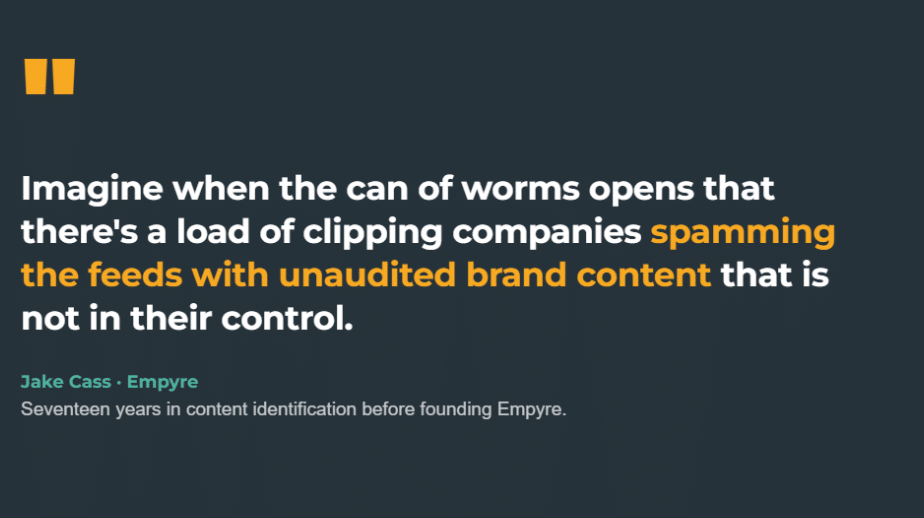
All of this sits in a legal gray area. Clipping is built on reposting, and for every clipper working directly with a copyright owner there are probably ten more sideloading someone else’s footage onto the platforms: scenes from films and shows, moments from other people’s streams, songs nobody licensed.
Evan Stanfield of Clipping Culture calls it “a little bit of a gray area” and says it happens constantly. Jake Cass spent seventeen years in content identification before founding Empyre, which licenses a creator’s footage to fans under an agreement that binds them to platform rules, and he describes the unlicensed version as a ticking time bomb. Even when the brand supplies its own footage, who owns the clips afterward depends on the agency. Lumina Clippers writes full rights into its clipper terms, others leave it to the brand to define, and at some shops the question is never asked.
Apart from the copyright question, the view count itself has pitfalls. Views can be bought, from services that sell them outright and from clippers who know where to buy, and the agencies range from checking every post to checking nothing. Clipster says it has banned more than 20,000 creators for it. Even an honest count shows only a number. It cannot say who watched or whether they had seen the brand before, and on an open campaign the brand rarely learns which accounts posted.
The clips sit on pages nobody vetted, next to political content, gambling and adult material, and a clipper chasing views can turn to rage bait with the brand’s footage. Disclosure varies. Some agencies require an ad hashtag on every paid post, others leave it to the brief. Cass raises the case that worries him most: a regulated advertiser, a casino or an alcohol brand, that would face age and targeting rules on a platform’s own ad system, and instead pays clippers to put the same message into feeds the algorithm alone decides, including the feeds of minors and addicts.
“We can’t turn shit into diamonds”
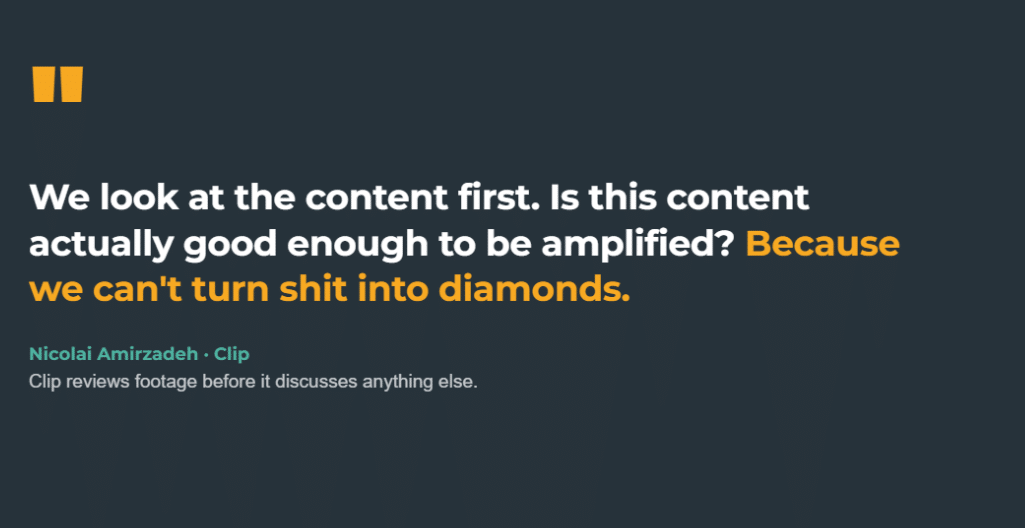
There is a reason clipping got its foothold with entertainment brands. It works best when people already want to watch the footage, when there is hours of it, and when the clip is itself the thing being sold, a song, a show, a stream, rather than something the clip has to point to. A podcast, a concert, a trailer all pass that test without trying. At Clip, Nicolai Amirzadeh’s team looks at the footage before it talks about anything else. “We look at the content first and see what their goals are,” he said. “Then we let them know, from our own view, is this content actually good enough to be amplified? Because we can’t turn shit into diamonds.” That is also what separates clipping from the tools a brand marketer already uses. UGC is a creator making something original about a product, usually on camera, for a flat fee. Whitelisting is a brand running ads from a creator’s own account. In clipping nobody makes anything new, so the footage decides everything.
The founders draw the hardest line around physical products. “I have yet to see anyone succeed with clipping for physical brands,” Selvi said. A product needs someone on camera holding it, and clippers do not show their faces, so those brands have stayed in UGC. The agencies that want their business say the fix is on the brand’s side. Alec Schweitzer of The Clip Ship sees the opening in “brands that are more open to testing and developing content from the ground up, and then distributing that with clipping.” The footage has to be worth watching before the product is in it.
Whether the model extends beyond entertainment, then, depends on brands making that footage, and on what they expect from it once they do. Rhys Mckay of Lumina Clippers is blunt about the second part. “It’s not affiliate marketing. Anyone who tells you that is lying. It’s not influencer marketing. Anyone who tells you that is lying. It’s awareness. It’s top of funnel.” Amirzadeh says clipping is already a line item in a few niches and becomes one elsewhere only when clients bring the agency into the wider marketing plan “instead of trying to fit clipping into this thing and think, nice.” The first buyers from outside entertainment have arrived. Mckay says the inbound in the last three months has come from large technology companies including a social media giant.
Subscribe to Our Newsletter
Check Out Our Podcast