

Tech
TubeBuddy’s ‘Content Outliers’ Bets YouTube Creators Want Proof a Format Works Before They Film

TubeBuddy’s new “Content Outliers” feature ranks YouTube videos by how far they beat their own channel’s typical results, then drafts a version a creator could make. The YouTube growth platform is betting that creators, facing rising production costs and AI-made content that increasingly looks the same, want proof a format works before they film it.
The look-alike problem is the one Cole Noel, TubeBuddy’s Head of Marketing, raises first. “You have to think every creator is using AI to an extent,” Cole says. “And what happens then is that everyone kind of starts making the same type of content.” Two years ago, he says, a good thumbnail designer made a video stand out. Now AI produces near-professional thumbnails for everyone.
Standing out from that crowd is the problem TubeBuddy, which serves more than 10 million YouTube creators, media companies and global publishers, now builds against. Cole, who started at the company writing copy, traces its roots to Keyword Explorer, a tool for finding trending search terms from the years when YouTube search worked much like Google’s. As YouTube put more weight on a video’s overall packaging, TubeBuddy added tools aimed at more clicks, views, and subscribers.
“Content Outliers” is the newest of those tools, and Cole’s case for it starts from the idea that creators rarely need to begin from scratch. “You don’t have to reinvent the wheel. There’s a template, there are patterns that work on YouTube,” he argues. TubeBuddy’s role, in his account, is to show creators which patterns work in their niche and on their own channel, at a point when misjudging one costs more than it used to.
Bigger Budgets Make a Flop Harder to Absorb
That cost has climbed with production values. Some creators now produce shows that cost more than shows on traditional media outlets, by Cole’s account.
“You can’t really afford nowadays to put that time and energy in and then the video flops,” Cole says.
Money is also pulling creators toward longer formats. Many now start on TikTok or YouTube Shorts, according to Cole, then try to move into nine-, 15- or 20-minute videos to earn AdSense revenue. “If you can get that same following but for your long-form videos, that’s where you can really start making this a career,” he explains.
One TubeBuddy user who builds cars from kits picks among three to five models by checking which draws the most search volume in Keyword Explorer. “Pick the wrong car, and then nobody’s interested in watching the video,” Cole says. Each of these creators needs evidence before production, and that demand produced “Next Video Ideas,” TubeBuddy’s AI ideation tool, in July.
‘Next Video Ideas’ Taught TubeBuddy What Creators Reject
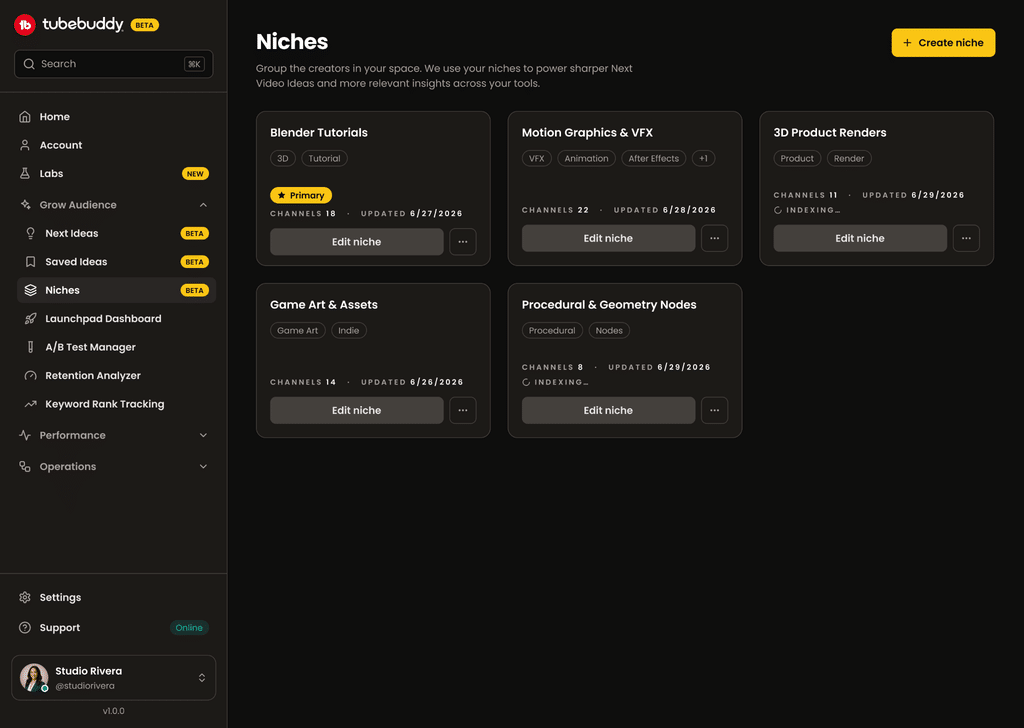
“Next Video Ideas” starts with a niche. Creators group channels that make content like theirs, and the tool pulls those channels’ top-performing videos, highest-clicking thumbnails, most-searched titles, and viewer comments, then weighs them against the creator’s own channel data.
Creators save or reject each idea, and rejections train the system. “A lot of times what you’ll see creators reject is if they just feel like it’s a little too outside of their comfort zone,” Cole notes. His example is the “MrBeastification” of YouTube, where a creator who prefers straightforward reviews gets told to add a challenge.

In July, creators saved roughly a third of the ideas the tool generated and rejected about one in ten, according to TubeBuddy. Over the past 30 days, both rates have come down: saves to about 31% and rejections to under 8%. The company attributes the lower save rate to a broader mix of users. It reads the drop in rejections as a sign that the ideas are getting better.
The tool also works as a route to paying customers. By the company’s figures, users who activate it are several times more likely to upgrade to a paid plan within a week than users who don’t. “Next Video Ideas” hands creators a finished list.

‘Outliers’ Measures Each Video Against Its Own Channel
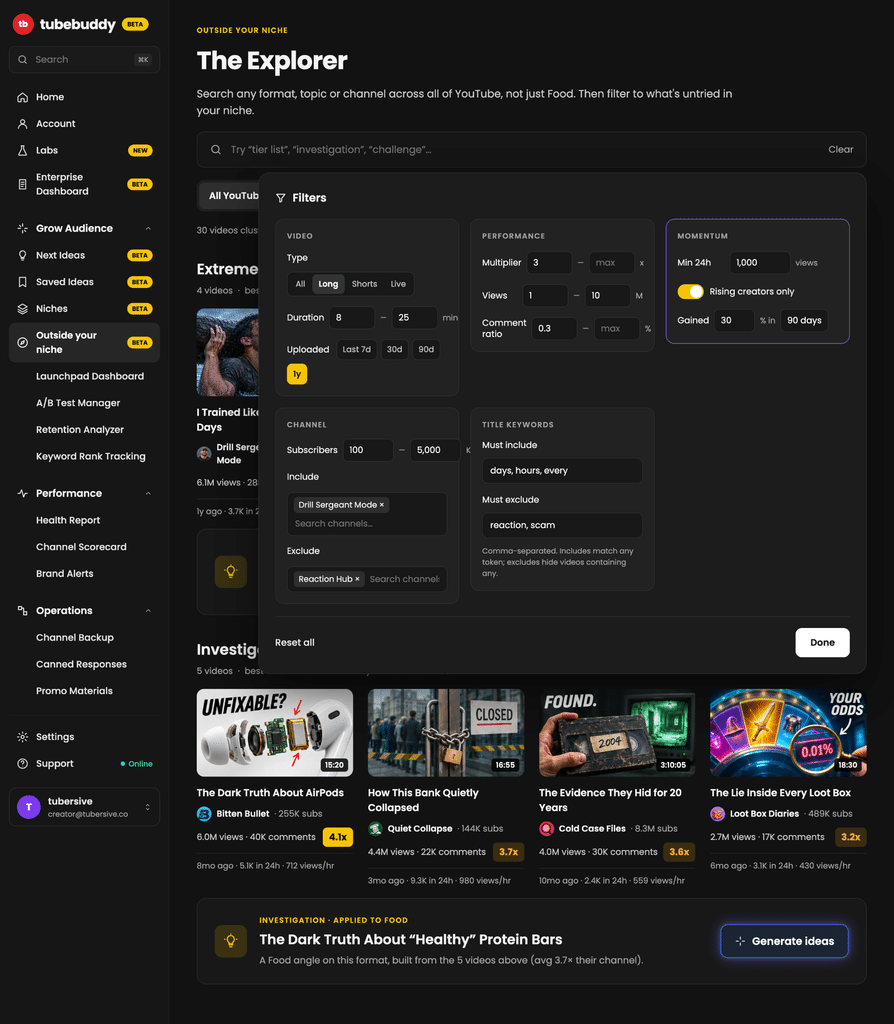
“‘Next Video Ideas’ is basically like the sausage, and ‘Content Outliers’ is like how the sausage is made,” Cole says. In his example, a channel that averages 100,000 views over three weeks and posts a video that reaches 300,000 in one week has an outlier worth studying, and the tool checks whether click-through rate, watch time, or engagement drove it.
In a demo using his own golf niche, Cole pulled up the top 60 outliers. One ran at 14.9 times its channel’s normal performance. A player’s transformation story beat its channel’s baseline by 2.7 times, and the tool proposed Cole’s own version, a journey to becoming the best golfer on his course.
Cole usually sorts the list by length. “You’ll see a lot of shorts are the ones that end up being the outliers because those are the ones that YouTube will recommend,” he points out. That filter keeps the list useful for creators moving into long form. A third view looks outside the niche entirely.
Untried Formats Come From Other Niches
That view, labeled “What’s untried in golf” on Cole’s screen, shows formats proven elsewhere that have not yet appeared in a creator’s niche. TubeBuddy is still dialing it in, according to Cole, because results pull heavily from other categories and include extreme cases. One channel averaging 747 views had a video reach 3.7 million. “Sometimes that’s just the wild west of YouTube,” he says.
His method is to find something similar enough to borrow. A video about building cats a warm, snow-protected balcony could become, on a golf channel, a video about building a home golf simulator.
If every creator borrows from the same breakout videos, though, the borrowing eventually feeds on itself, a risk Cole raises himself.
Proven Patterns Still Need the Creator’s Personality
Cole compares the current cycle to a snake eating its own tail. A prevailing message at VidSummit, he recalls, was to take a video working on another channel and change the idea slightly, so a viral review of the cheapest hair products on Amazon becomes one on the cheapest golf equipment. “Does that just repeat infinitely? I don’t know. I hope so,” Cole says, adding that he expects a creative breakout at some point.
His answer for TubeBuddy’s users is that the tools blend what works across a niche with what works on the creator’s own channel, so the output differs by creator. “TubeBuddy is a toolbox. It’s designed to help you. It’s not designed to tell you exactly what to do,” Cole argues.
The rest has to come from the creator. New creators, in his view, still have to play the game to an extent, the way a website once had to follow Google’s structure to rank however well it was built. Cole adds that TubeBuddy can do little for a beginner who expects a subscription to guarantee growth. “Content is king, and it still is,” he says.
Next, TubeBuddy Grades Videos After They Go Live
Judging whether that content landed is the job of TubeBuddy’s next tool. “Video Optimizer,” currently in a silent beta available to 25% of users ahead of a public launch in early December, runs a postmortem on a published video, showing what worked and letting creators make changes on the spot. TubeBuddy, which GameSquare Holdings acquired from BENlabs in February 2026, is also building a shared data layer with GameSquare’s gaming analytics platform, Hatchet and TwitchMetrics, targeted for December 2, with Keyword Explorer set to surface that data first.
Cole’s advice to a creator opening TubeBuddy this month follows the same evidence-first logic as “Outliers.” Build a niche of comparable channels, study what their titles, descriptions, and thumbnails are doing, and check each idea against search demand before filming.
“You’d be surprised at how a little bit more effort into the packaging, positioning and research behind your video can really help it be successful on the back end,” Cole says.
Subscribe to Our Newsletter
Check Out Our Podcast