






Tech
JetBrains Spinout Kineto Launches an AI Agent for Operational Work Behind Influencer Marketing

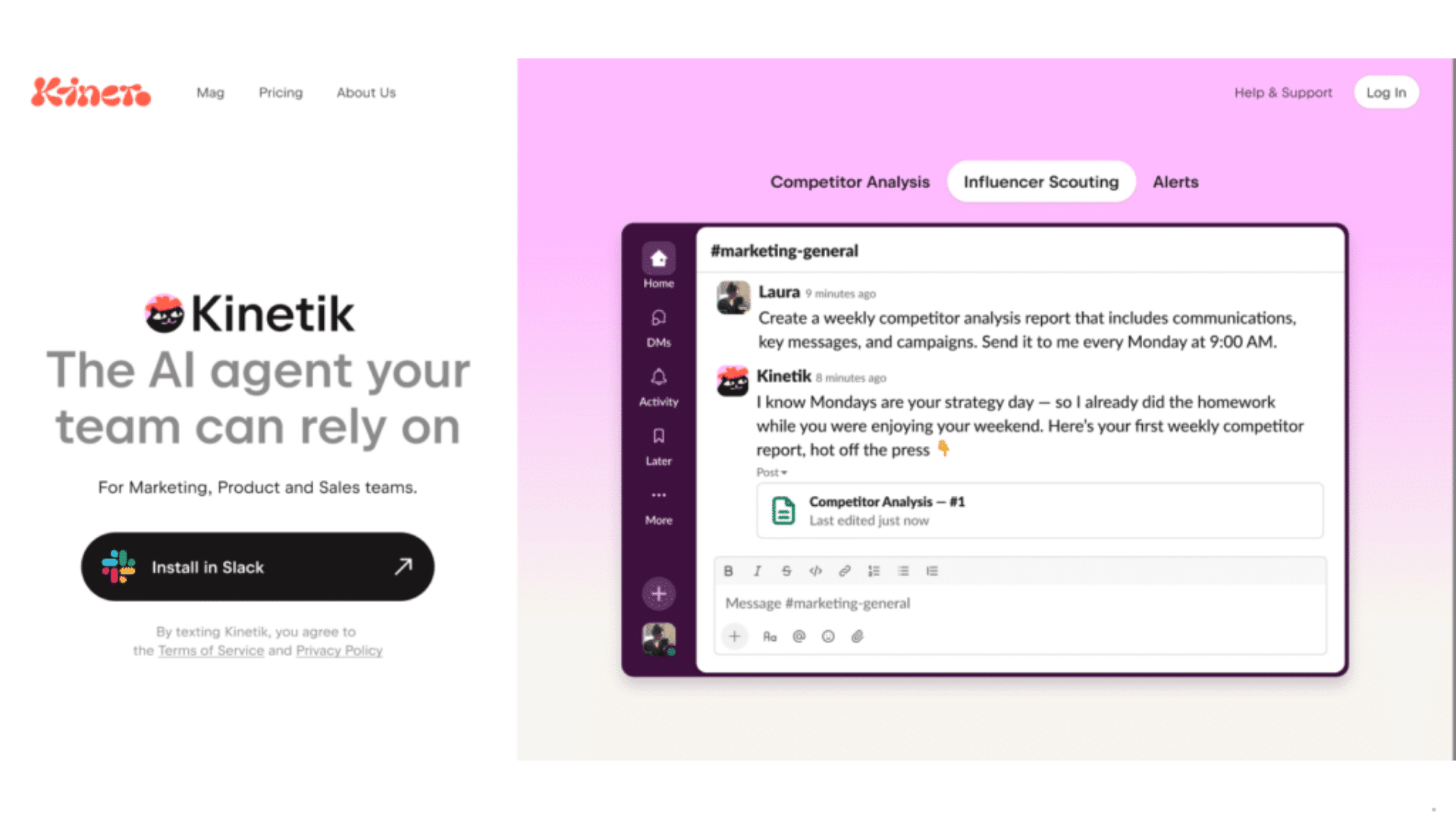
Kineto, an AI company spun out of JetBrains, has launched Kinetik For Teams, an AI agent for influencer and content marketing that operates inside Slack and WhatsApp. Andrew Zakonov, the company’s CEO and co-founder, built it on a conviction developed while overseeing Junie, JetBrains’ coding agent: AI agents create the most value not in creative work, but in the operational tasks that surround it.
In Influencer Marketing, Andrew estimates, roughly 90% of a campaign’s work is operational: scouting creators, drafting outreach, tracking negotiations, and compiling performance data. The remaining 10%, strategy and creative judgment, is where humans still lead. That split, in his analysis, makes Influencer Marketing an unusually strong fit for a specialized agent.
“When we know some specific area or domain we want to focus on, we can create a tool specifically for that domain that’s dramatically more efficient,” he says.
Andrew brings 15 years of AI and product experience to that argument. Before Kineto, he scaled ML-powered products with up to 80 million monthly active users. Then, he joined JetBrains in 2022 to lead product for Junie and the early Kinetik platform before becoming CEO and co-founder of Kineto in December 2025. The company, based in London, subsequently spun out of JetBrains as an independent startup backed by JetBrains investment and engineering expertise.
Kinetik For Teams targets marketing teams, agencies, and founders running social and influencer programs and starts at $50 per month for teams of up to 100 people. Getting to a team product required solving a design problem Andrew had not anticipated when Kineto began running Kinetik inside its own Slack.

Why General-Purpose AI Leaves Influencer Workflows Unfinished
Marketing teams using AI tools for influencer work face the same problem. Each team member teaches ChatGPT or Claude what the brand does, what platforms it uses, and how it has worked with creators before. That context does not compound across the team, and it disappears when the session ends.
According to Andrew, a specialized agent holds that context permanently and applies it from the start. For Influencer Marketing specifically, that means a tool that already understands creator discovery, outreach dynamics, and social analytics without needing to be primed before each conversation.
The operational overhead framing is central to how Andrew positions Kinetik against general AI. Scouting hundreds of creator accounts against a brief, checking engagement rates, drafting personalized outreach for dozens of contacts, tracking negotiations and compiling performance data are all tasks he argues AI agents handle better than humans at volume. “That’s the sweet spot for agents,” he says. “That’s something we could really improve.”
One Shared Agent, Two Problems
The two months Kineto spent running Kinetik internally before the team launch produced a design insight that most shared AI tools have not addressed, says Andrew.
The first version gave each team member their own Kinetik instance, a direct port of the personal agent model. The problem appeared quickly as 10 people were each building the same context, writing the same prompts, and sharing them in a chat to avoid duplicating work. The pattern replicated what Andrew sees in most companies using general AI: opaque personal setups that do not compound across the team.
The fix was a single shared agent. The agent learned the company’s Instagram account, campaign history, and brand context once, and everyone who came to it found it already informed. “When I come to Kinetik and ask about our Instagram account, everything is connected, prepared,” Andrew says. “Kinetik is kind of an expert in our Instagram.”
A second problem followed. Andrew prefers concise output. Other team members wanted detailed responses, more visuals, longer text. The shared agent began averaging across those preferences. “It became a generic version of something that nobody likes,” he says. “Like a generic restaurant that has everything for everyone, but nobody really enjoys it.”
The current architecture separates two layers: a shared knowledge base covering company, account, and campaign context, and individual personalization that preserves how each user prefers the agent to communicate. Andrew describes it as “a really deep technical problem” and says the team continues to invest in it.
Creator Discovery Runs on Feedback, Not First Results
A marketer starts a creator search by sharing a brief with Kinetik in any format (a PDF, a voice memo or plain text). The agent researches against the brief for 10 to 20 minutes and returns a scored shortlist, ranking creators on reach, relevance and brand fit while flagging fake engagement.
“It’s very easy to provide some feedback,” Andrew says. “You can say I want higher engagement rate, I want U.S.-based influencers, whatever.” Each iteration narrows toward the actual requirements of the brief. A marketer can also ask Kinetik to assess a specific account: whether it is a good fit for a particular company or campaign.
Once a shortlist is set, Kinetik can draft outreach materials. Email initiation and follow-up tracking are in development and not yet publicly available. Andrew’s longer goal is for the agent to manage the full campaign arc, from discovery through reporting, with humans making the decisions that require judgment and Kinetik handling the steps between them.
An exercise he runs with marketing teams involves drawing a full campaign timeline and color-coding each task. Green for what the team wants to keep. Yellow for what can be delegated to Kinetik now. Red for what they want to hand off eventually. “Now it’s definitely much more human time spent than Kinetik time spent,” Andrew says. “But we want to maximize Kinetik’s share.”
Trust Starts With What You Share
Kinetik connects to nothing by default. When added to a Slack workspace, it starts with no access to external tools, analytics platforms, or existing conversations. Teams connect accounts, such as Google Analytics, Notion, or social handles, step by step, only where they choose.
“When a new person joins our company in Slack, we know how to share access to some stuff and not to other stuff,” Andrew says. Teams already carry that mental model from years of Slack use. Adding Kinetik to a channel means it sees that channel.
That design choice, Andrew argues, also flattens the learning curve. Because teams already know how to manage Slack access, Kinetik requires no new mental framework to get started. SOC 2 certification is underway, a requirement he frames as standard for enterprise contracts.
Why Influencer Marketing Has Stayed a Large-Brand Activity
The market case Andrew makes for Kinetik is not primarily about making large influencer programs more efficient. It is about making smaller programs viable.
“Influencer Marketing is amazing, and a lot of founders understand why it’s great,” he says. “But the operational overhead is crazy. Only large brands and large campaigns are done that way.” In his read of the market, smaller companies understand the value of creator marketing but cannot absorb the weeks of operational work each campaign requires. The barrier is time.
If Kinetik reduces that load, Andrew expects the practice to extend into companies that currently cannot run it at all. “I would be happy to see five-person companies, some startups, doing Influencer Marketing,” he says. “It would be amazing for everybody on the market, for influencers, for founders, for smaller products, for smaller businesses.”
A More Creative Job, by Default
Kinetik’s next phase, in Andrew’s framing, is not about replacing marketers but about shifting what they spend their time on.
Running more campaigns over the same period is the first outcome he describes. The second is a redistribution of energy within the workflow, away from coordination and toward creative work. “I do believe that we can shift that split from spreadsheets,” he says. “Marketing is a lot about creativity. That’s the great part. Not about Excel spreadsheets.”
His near-term roadmap includes public release of the email outreach and follow-up feature, continued refinement of the shared-knowledge-plus-personalization architecture and deeper integrations with analytics platforms. For teams considering whether agents are ready for their workflows, his advice is to start with a brief and see what comes back.
“Specialized agents can make a huge difference already today,” Andrew says. “A lot of marketers and influencers underestimate what’s possible when done correctly. And it’s actually fun.”
Subscribe to Our Newsletter
Check Out Our Podcast