
Tech
Billion Dollar Boy’s Companion Launches Creator Pricing Tool to Give Brands a Benchmark for Negotiations

Companion, the creator tech platform within Billion Dollar Boy (BDB) Group, launched Creator Investment Intelligence in July 2026, a pricing tool built on $173 million in verified creator campaign spend and more than 180,000 deal data points across more than 50 territories. The product pairs a benchmark algorithm with a centralized budget tracker to give brands and agencies a shared standard for negotiating creator fees.
“What a creator should be paid is a topic that has, for the whole life cycle of creator marketing, been a question that causes a lot of anxiety on both sides of the equation,” says Thomas Walters, co-founder and Chief Innovation Officer of London-headquartered BDB Group. “I don’t think we’ve seen any meaningful steps towards resolving that.” Thomas has spent more than 12 years at the company, moving through client services, global strategy, and regional CEO roles to his current position overseeing innovation and group strategy.
His account of what has driven demand for the tool centers on scale rather than novelty. What were once test-and-learn creator budgets have grown to the point where companies like Unilever reference influencer investment in quarterly earnings calls. “That’s a massive change in the way that investment is considered,” Thomas says. As those budgets have increased, so has the volume of governance questions arriving at the company from agency clients and brands licensing Companion directly.

Follower Counts Were Never the Right Metric
The pricing problem, Thomas says, predates the current governance conversation. “It’s always been challenging. I really don’t think this is a new problem,” he says. What has changed is the cost of getting it wrong. As more buyers have entered the market with larger budgets, pricing volatility has become an increasingly expensive variable for brands to absorb.
Agents sometimes transfer pricing expectations from a creator who commands high fees based on demonstrated performance to a different client based on follower count alone. “You see certain individuals being able to command very high fees justifiably,” Thomas says. “But then you might have agents going, ‘I think the value is based on the follower count alone.'”
Companion’s benchmark algorithm accounts for what follower counts miss: deliverable type, usage rights, creative craft, and organic performance metrics. “The price that is reasonable for a creator’s charge is based on numerous criteria,” Thomas says. “And it should be based on authenticated data, not on estimated data.”
Spreadsheets Out, Centralized Governance In
The mechanics of Creator Investment Intelligence begin before any team member accesses the tool. Companion first runs an assessment of a brand’s existing deal history against the benchmark, giving marketing and procurement leadership a view of where current spend sits relative to market rates before the guidance rolls out organization-wide. “Week one is about that assessment window,” Thomas says, followed by team training and a full system launch.
Once live, the replacement of fragmented tools is complete. “Spreadsheets are gone; the tool is in. There’s not a hybrid version that works,” Thomas explains. Every creator quote and final fee is entered into a single centralized dashboard, giving leadership real-time visibility across teams, markets, and campaigns. The system’s intelligence depends on what goes in. “Your data only works as hard as your data quality,” he says.
The centralization has a rationale beyond price management. Companion commissioned a survey of 1,000 marketing and procurement leaders in the United States and United Kingdom and found that 49% identify managing creator budgets across teams, markets, and regions as a leading concern. Thomas describes situations where separate teams within the same global organization negotiate independently with the same talent agencies, sometimes agreeing to different rates for the same creator without knowing what another team has already committed to.
The Mispricing Problem Cuts Both Ways
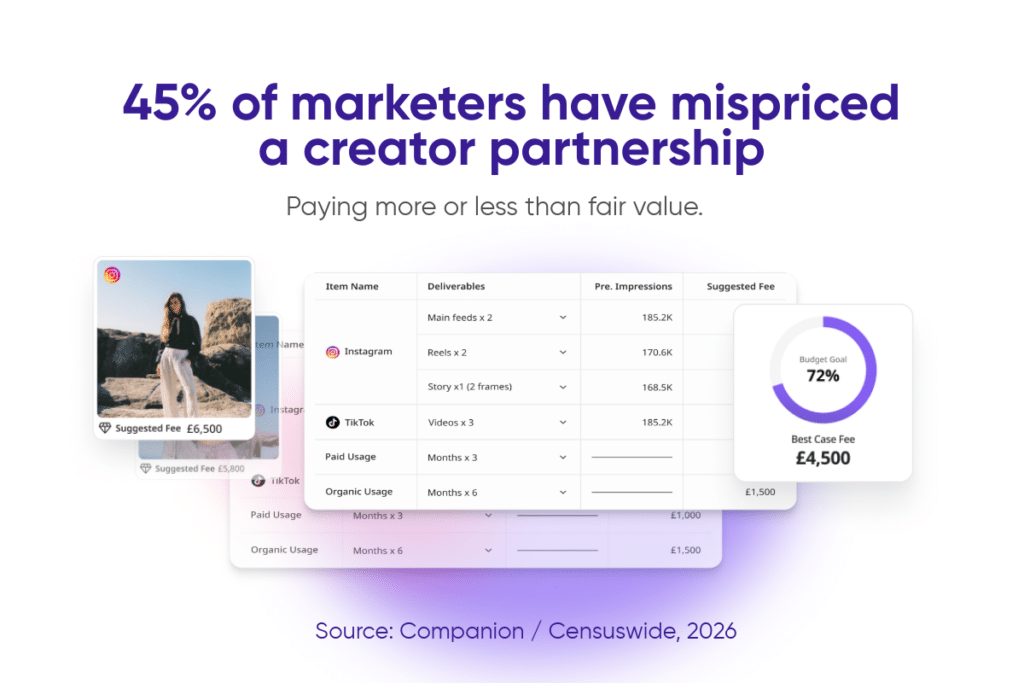
The same research found that 45% of brands admit to mispricing creator partnerships. The distribution spans both directions: 40% paid above fair value, 36% paid below. The overpayment figure is the more straightforward case for procurement to engage with. The underpayment risk is less discussed but, in Thomas’s account, equally consequential.
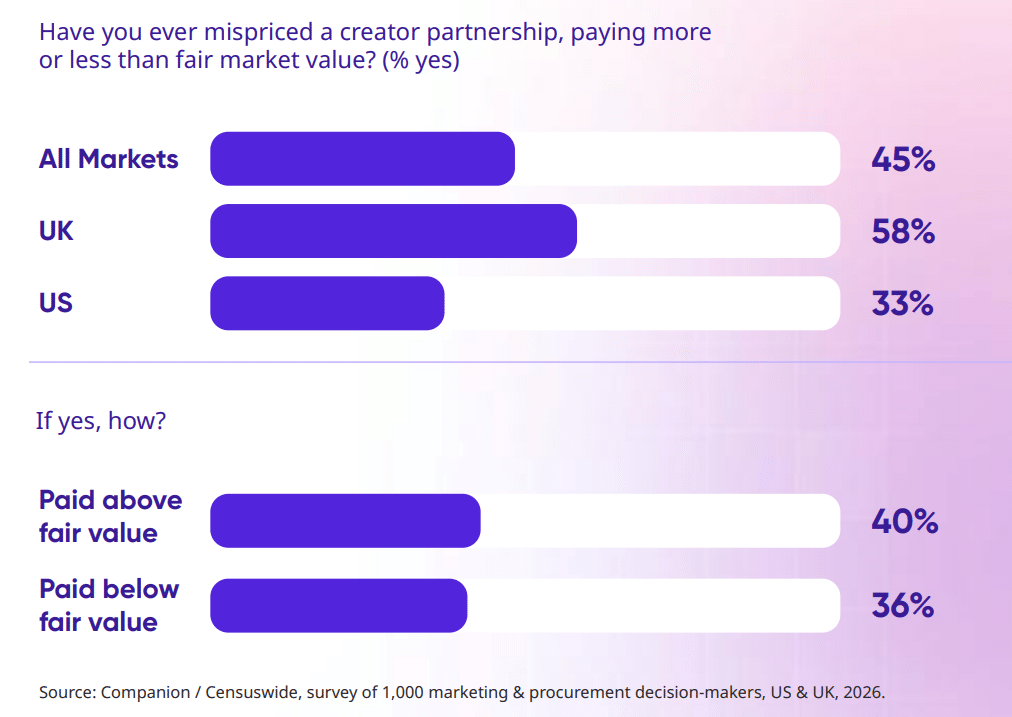
Image credit: Companion / Censuswide
“Are you being so aggressive in that market with those individuals that you are at reputational risk?” Thomas asks. “There’s plenty of platforms out there where people are going to flag that that’s the case, or they’re going to speak to their contemporaries and say, ‘Don’t work with that brand. They’re really hard work, and they’re not going to pay you a fair rate.'” Creator networks share information, and a reputation for aggressive negotiation can close off access to talent that would otherwise be available.
Companion’s aim, Thomas says, is to determine market value, not cost reduction. “We’re solving for both,” he says. For brands whose procurement teams are focused on the savings case, the reframe is that the benchmark sets a floor as much as a ceiling, protecting the talent relationships that sustain creator marketing over time.
A Benchmark Built From Its Own Deals
The benchmark algorithm draws on deal data accumulated through BDB Group’s own agency operations. Companion operates as a separate legal entity from Billion Dollar Boy with its own team and commercial structure, Thomas notes. But both sit within BDB Group, and the data underlying the pricing standard was generated through the agency’s work with clients.
The dataset, Thomas says, was built to capture market breadth rather than BDB’s footprint alone. “We aren’t benchmarking against a limited, isolated snapshot. That dataset reflects a global mix of clients, industries, and creator tiers.” Proprietary client details and identifying metadata are stripped before any deal contributes to the benchmark, ensuring that no brand’s commercial terms are visible to another organization using the platform.
The upfront audit provides an additional verification layer. Before the system goes live internally, a brand’s leadership can review how their own historical deal data compares to the benchmark, market by market, including cases where a brand may consciously choose to pay above benchmark for strategic reasons. Thomas argues this gives brands a concrete basis for assessing the benchmark before committing to it as a governance standard.
Data Provides the Starting Point. Teams Close the Deal.
Creator Investment Intelligence is designed to reduce pricing uncertainty, Thomas notes, not to replace the judgment required to close deals. Junior team members often lead creator fee negotiations at the brand or agency level, carrying limited experience into discussions with agents who work the market full-time. The benchmark gives those teams a defensible position to take into negotiations and to justify internally.
“You might think that’s expensive because you’re not involved in the creator space, but this person’s really in demand,” Thomas says, framing the internal case a marketing team can now make to procurement or a CMO. “This is what Companion tells me a fair market value is.”
The algorithm calculates based on deliverable parameters and predicted performance data. It does not assess cultural momentum, the depth of a creator’s relationship with their audience, or production capabilities that might justify a premium above benchmark. “Teams need to bring strategic judgment, negotiation nuance, and human connection,” Thomas says. A creator might warrant payment above benchmark for capabilities or cultural positioning the data cannot capture, and a human team is still required to make that judgment.
The Infrastructure Creator Budgets Now Require
Two additional Companion features are scheduled for September, Thomas confirms, extending the system into how brands can use investment intelligence to plan and understand their market position.
The broader pattern Thomas identifies is professionalization. Creator marketing has moved from a channel where brands could absorb pricing ambiguity as a cost of experimentation to one large enough to draw scrutiny from procurement departments and surface in investor disclosures. Companion’s commissioned research found that only 44% of brands say they retain full confidence in their ability to negotiate creator fees effectively, a figure that defines the addressable market the platform is targeting.
“Data gives you confidence to step into the room,” Thomas says. “Your team turns that confidence into a high-performing partnership.”
Subscribe to Our Newsletter
Check Out Our Podcast