




Platform
Swoveralls, DudeRobe Spent More Than $2 for Every $1 in TikTok Shop GMV During Four-Month Affiliate Push

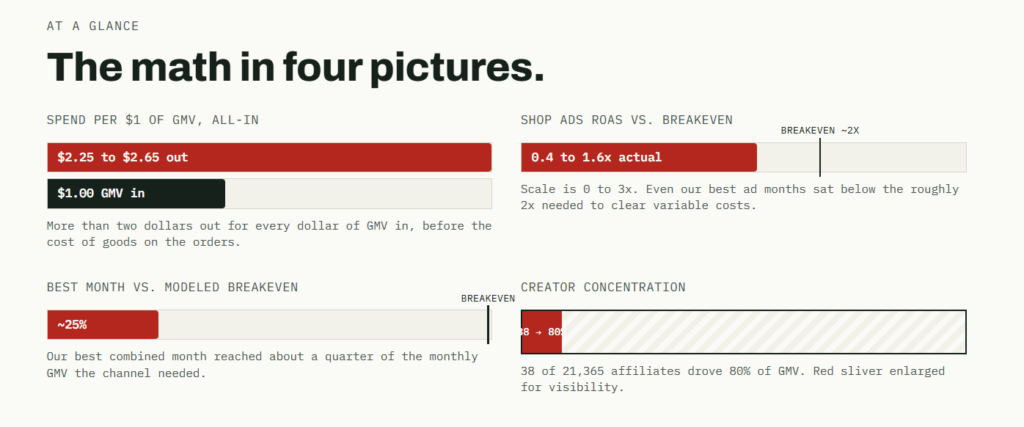
Swoveralls and DudeRobe spent more than $2 to generate every $1 of TikTok Shop gross merchandise value during a four-month affiliate campaign, before accounting for the cost of goods, according to a field report from the brands’ operators.
The four-month experiment, which ran from April through July, was designed as a large-scale test of TikTok Shop’s affiliate model. The brands shipped 4,752 samples, enrolled more than 21,000 creators, offered commissions of 12% to 20%, and added five-figure incentive programs and Shop Ads spending. The economics ultimately pushed them to reallocate spending toward a smaller group of proven creators and paid media.
The report, authored by Kyle Bergman, founder of Swoveralls and managing director of DudeRobe, and David Silverander, founder of Kelson Agency, details where the model broke down. Shop Ads returned between 0.4x and 1.6x against a calculated breakeven of more than 2x, while the brands’ best combined month reached only about a quarter of the monthly GMV their model required to break even.
A Cold Start Made More Expensive by Scale
The brands launched what the report describes as a “maximalist” approach, ramping sampling each month toward a peak of roughly 1,850 combined units rather than starting with a narrow test.
The result was an expensive discovery process. Every sample shipped generated less GMV than it cost to produce and ship, according to the report, before commissions, platform fees, or labor were included.
That finding matters because product sampling is often treated as a cost of getting creators into an affiliate program. The brands’ experience led them to a different conclusion: each sample was effectively a customer-acquisition expense that needed to be measured against the sales it generated.
That is particularly important for new TikTok Shop sellers, where creators and the platform’s recommendation system can favor products that already have a sales history. Without that history, brands may need to spend simply to generate the initial activity that makes the products more attractive to creators.
Swoveralls and DudeRobe’s report suggests that scaling sampling before identifying which creators and content formats worked turned that cold-start challenge into a much larger expense.
38 Creators Generated 80% of Affiliate GMV
The strongest signal in the campaign data was how concentrated sales became once creators began generating revenue.
Of the 21,365 creators who joined the two brands’ affiliate programs, just 38 accounted for 80% of affiliate GMV. One creator generated roughly 30% of the total. About 99% of enrolled affiliates generated no sales, while only roughly one in eight ever posted a shoppable video.
The distribution changed the economics of the brands’ approach. Recruiting thousands of affiliates created a large pool of potential partners, but the overwhelming majority generated no measurable sales. The value was concentrated among a very small group of creators who proved they could convert.
That concentration suggests a different model for the brands going forward: use TikTok Shop to identify creators with demonstrated performance, then build deeper relationships with the small group that actually moves product.
It also helps explain why the brands’ broad recruitment strategy struggled to reach breakeven. The number of affiliates grew dramatically, but sales did not grow proportionally because most of those creators never became active sellers.
The Brands Tested the Halo Effect
The brands also looked beyond TikTok Shop’s direct GMV to determine whether affiliate activity was producing an incremental lift on other channels.
They found no apparent lift on Amazon. One brand’s Amazon revenue was lower during the campaign than before it, while its heaviest sampling month coincided with its weakest Amazon month of the year.
That matters because a broader sales impact can potentially justify an otherwise unprofitable affiliate program. Without evidence of that incremental effect, however, the brands had less reason to treat TikTok Shop losses as an investment in overall commerce.
The report draws a distinction between assuming that a channel creates a halo and measuring whether it actually does. As the brands put it, “a halo you assert is a plug number and a halo you measure is evidence.”
That measurement discipline also changes how the campaign’s results should be interpreted. The brands are not arguing that TikTok Shop has no value. They are arguing that an unmeasured halo should not be used to make an otherwise unprofitable affiliate model appear economically viable.
From Mass Recruitment to Proven Creators
The brands are now keeping a minimal TikTok Shop storefront while shifting spending toward direct relationships with a smaller group of proven creators.
Rather than relying on TikTok Shop’s affiliate structure to monetize every creator relationship, the new approach is to license content from creators and run it as paid media to the brands’ own sites.
The shift turns the campaign’s biggest finding into a new acquisition strategy. Instead of spending heavily to recruit and sample thousands of creators in the hope that a few will emerge, the brands can use performance data to identify those few and concentrate spending there.
For Swoveralls and DudeRobe, the four-month experiment therefore produced a narrower conclusion than simply whether TikTok Shop works: scale alone did not make their affiliate model economical. The sales were concentrated among too few creators to justify the cost of broad recruitment, sampling, and incentives.
Subscribe to Our Newsletter
Check Out Our Podcast