








Influencer
Why Measurement Consultant Jim Gianoglio Judges His ‘Measure Up’ Podcast on a 1-to-10 Scale of Fun

Jim Gianoglio was barely past introductions on a Zoom sales call when the prospect’s CEO spoke up. “I can’t believe it. I’m talking with the Jim Gianoglio,” the executive said, explaining that he had listened to every episode of “Measure Up,” the podcast Jim co-hosts. For someone who quantifies marketing’s impact for a living, the moment came with a caveat.
“I can’t say that the podcast caused that client, but it certainly helped,” Jim says. As founder of Cauzle Analytics, he helps companies understand what their marketing contributes to sales and leads through marketing mix modeling (MMM) and incrementality testing. He treats the podcast, the MMM Hub newsletter and the MMM Hub Slack group as “fun side quests,” and anything the podcast produces as “just a cherry on top.”
That framing extends to how he grades the show. In its early days, he tracked downloads and listens on Apple and Spotify and watched them grow. He has since stopped looking. “The metric would be how much fun I’m having on a scale of 1 to 10,” he says. “At the point where it stops being fun is when I’ll stop doing it.”
A Shuttered Adventure Magazine Sent Him Into Analytics
Jim’s route into measurement began with a publication going under. After working as a newspaper photojournalist, he joined Glucose Magazine, a small regional title covering adventure and outdoor sports, where for six months he went mountain biking, kayaking and rock climbing, then photographed and wrote about it.
Then the publisher lost his funding, and the magazine closed. “I was like, ‘What am I going to do now?'” Jim recalls. The move into SEO and analytics that followed came from “necessity, primarily,” he says.
The career change did not settle his restlessness. Since college, when he switched from graphic design to computer science and back to photography, he has swung between creative and analytical work. “The need to exercise my creative juices has been important,” he says. Years later, bored with repeating the same work, he started the newsletter as that outlet.
The Silver Bullet That Never Worked
The conversations Jim kept having with clients and colleagues before “Measure Up” carried one message. “Hey folks, last click doesn’t work. And guess what? Neither does multi-touch attribution,” he says. People, in his telling, were and still are obsessed with “that single answer, that single silver bullet.”
At the time, Apple’s tracking updates such as Intelligent Tracking Prevention were eroding user-level measurement across touchpoints, and GDPR was already in force. To Jim, every signal pointed at a methodology the industry had treated as ground truth for years. “It really, truly never worked as much as we believed it did to begin with,” he says.
His own assumptions have shifted too. He once held, fairly strongly, that with enough data everything could eventually be measured and explained. The longer he has worked in the field, the more nuanced that view has become. Recognizing how much uncertainty lies beyond measurement “gives you a little bit of a healthy humility on what you can and can’t measure,” he says.
A LinkedIn Post Asking to Be Talked Out of It
After about a year of the newsletter, Jim wanted something less solitary. “With newsletters, it’s a very lonely thing,” he says. “Very rarely will you get anyone that replies.” A podcast offered a feedback loop and a reason to talk directly with people in the industry.
He posted on LinkedIn asking, as he remembers it, for someone to talk him out of starting a podcast. “Everyone responded, ‘No, do it, do it,'” Jim says. He set no audience or monetization targets. The show was partly an excuse to buy gadgets, including his microphone, and partly an excuse to talk with people he looked up to.
He expected guests to turn him down. After the first three or four episodes, he realized that everyone he asked said yes. “You can usually punch above your weight,” he says. “Chances are they’re going to say yeah.”
A Co-Host Who Supplies the Analogies on the Spot
Simon Poulton first appeared as a guest and became co-host five or six episodes later. The pairing covers a weakness Jim names directly. “I tend to have to sit and think about something for a long time before I have something intelligent to say,” he says. Simon, by contrast, “always comes up with analogies on the spot that just hit really well.”
The workload splits along similar lines. Both men pitch guests; Jim drafts an outline of two or three core topics with sample questions, and Jim edits the video and audio in Descript, a job AI has made faster. Topics drive guest selection. Retail media made the list because Simon worked with it in his job and its importance kept growing. Inbound requests are rarely useful, since most are blatant pitches, often from companies placing their clients, which Jim calls “terrible.”
The harder discipline is restraint. Jim describes “the curse of knowledge,” where veteran hosts and an expert guest dive into details “where you lose 99% of the listeners.” Keeping the conversation at a level most people can follow remains the challenge, he says.
Five Months Quiet and Waiting on an Agentic Workflow
“Measure Up’s” cadence has slipped. In its first year, Jim released an episode every two weeks and missed only a handful. Since then, busy schedules and a coast-to-coast split with Simon have made booking harder, and at the time of the interview, the latest episode dated to June 3. “This is something that obviously I’m struggling with,” Jim says.
Part of the problem is priority. Around the time of that episode, he revived the newsletter after a hiatus, and AI has cut his weekly time on it from three to five hours to about an hour. He wants the same efficiency for the podcast, and he suspects that ambition has become part of the obstacle. “I’m like, oh, well, I should create an agentic workflow first,” he says. “But no, I should probably just book a guest and do it.”
If he could keep only one project, Jim would choose the Slack group. Members hold conversations without him, and it has brought him business. “It’s its own thing now with or without me,” he says.
Skills Files Are Changing How Marketing Mix Models Get Built
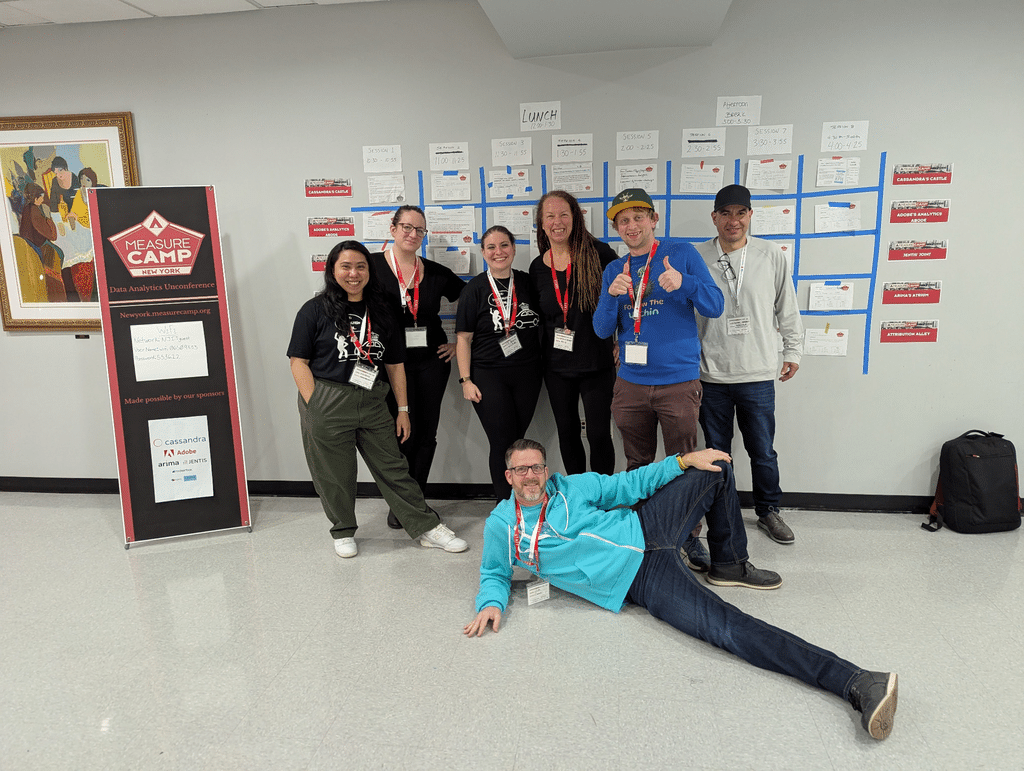
AI has taken over Jim’s industry’s conversations. At the three MeasureCamp unconferences he attended over the past year, including one in Washington, D.C., at least half the sessions touched AI. On “Measure Up,” episodes about MMM tend to be very popular based on downloads and listens, though he never meant the show to center on his specialty.
He sees AI converging with open-source packages such as Google’s Meridian and PyMC-Marketing, tools that did not exist five years ago. The weak point is unguided use. Ask Claude to build an MMM with one of those packages, Jim says, and it will. “The code will run without errors, but the model will be shit,” he says. “It’s not valid.”
The answer, in his view, is skills files that spell out how to build the model, which checks to run and what defaults to set for the priors. With that guidance, he says, the output “can actually get really close.” Google included skills files for LLMs in Meridian’s 2.0 release, and PyMC-Marketing has been building that way for more than a year.
That combination puts paid platforms under pressure. “I think it’s going to be a very tough time for SaaS vendors in this space over the next two, three years,” Jim says. He expects vendors with a real differentiator to survive and those without one to fall away, adding, “We’ll see.”
Start With What You Have, Then Iterate
The advice Jim gives a brand thinking about launching a podcast mirrors how he builds models. “Just start and try not to wait until everything is perfect,” he says. He warns against spending months researching microphones and software. In marketing mix modeling, he explains, you start with what you have, get a first model and improve from there.
It is also the advice his own show is waiting on. A consultant who has learned to accept how much stays beyond measurement runs his podcast on the same terms, with no download goals, no fixed schedule, and a payoff he cannot fully attribute. What it needs next is another guest.
“You got a laptop, you got Zoom, boom, you’re done,” he says. “Start it there and then iterate.”
Subscribe to Our Newsletter
Check Out Our Podcast