Technology
Upfluence Turns Its Creator Marketing Platform Fully Agentic, Betting AI Can Run Campaigns End to End

Running an influencer campaign has always required someone to find creators, write outreach, handle negotiations, review content, and file reports. On September 9, Influencer Marketing software platform Upfluence told its customers an AI would handle most of that for them. The question for every team that adopts it is what they remain responsible for when the machine is running the campaign.
Vivien Garnès, Kevin Creusy and Alexis Montagne co-founded Upfluence in 2013, built around a thesis that small ecommerce brands needed Influencer Marketing infrastructure comparable to what large companies could build internally. Vivien operates from Lyon, France, while Kevin is based in New York. After nearly 15 years building toward that mission, both see the September 9 relaunch as the moment the platform’s capabilities finally align with its original intent.
“It’s such a systematic change in the industry,” Vivien says. “It’s exciting to be in a place where you can really push the envelope and change the usage at this scale.”
The company now serves more than 1,300 clients, who have collectively run over 35,000 creator programs through Upfluence in the past four years. In 2025, the previous AI-assisted version of Jaice, the company’s AI, helped brands hire 160,000 creators, according to the founders. The agentic relaunch changes the marketer’s role from operator to supervisor. “You go from running creative programs manually with a team of two people working non-stop,” Kevin says, “and suddenly you have an AI that becomes your team.”

Kevin Cruesy & Vivien Garnès
Jaice Builds the Campaign Strategy Before the Marketer Has Written a Brief
Kevin describes Jaice’s starting point as a company’s domain name. The system identifies the brand, builds a profile from publicly available information, proposes a creator strategy, and surfaces a curated shortlist before the marketer has defined a campaign brief. For brands with clear requirements, Jaice writes the outreach sequence, publishes the brief, and manages the follow-up schedule that previously took a campaign manager four to five hours to draft.
The system also covers the back-and-forth that fills campaign inboxes. Upfluence is currently testing this capability in-house. In early internal data, roughly two out of three creator-brand exchanges, including availability checks and rate discussions, can be resolved by Jaice without escalating to a human. “The AI knows what it’s doing,” Kevin says. “The setup is cleaner, the conditions are clearly stated.”
Beyond outreach, Jaice can pull campaign performance data, summarize activity during a manager’s absence, and process approvals in bulk. Kevin describes a customer who ran full campaign reports through the system, a use case the company had not anticipated. “I was like, ‘I don’t think it should do this,’” he says. “But if it can and it works, who am I to judge?”
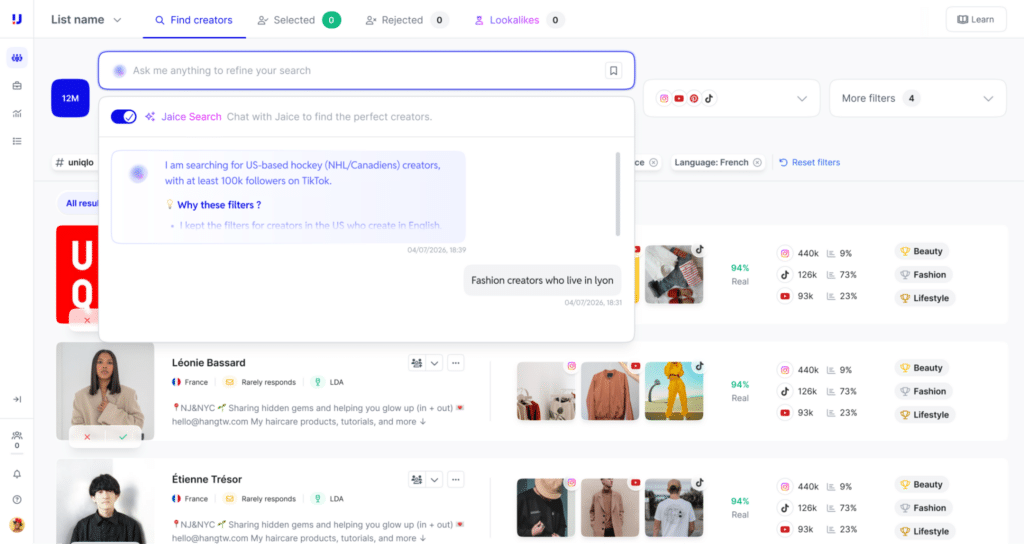
Image: Jaice search
AI-Written Outreach Is Generating Higher Reply Rates Than Human-Written
The case for automating outreach usually rests on efficiency. At Upfluence, early data shifted the argument toward quality. Jaice-written outreach emails commanded a 22% higher reply rate than human-written messages from the same campaigns, according to Vivien. “For me, the big shift was not just about speed. It’s actually about quality,” he says. “We have a system so well trained that it outperforms humans whose job it is to do this.”
Kevin attributes part of the improvement to consistency. Human-drafted outreach varies in quality and often reads as generic. Jaice draws on the creator’s full profile and personalizes within a defined range. “The AI has the full profile of the creator and is going to say, ‘Hey, love what you have been doing with that other brand three weeks ago. Would you be interested in taking part in our campaign?’” he says.
Vivien draws a line between calibrated personalization and the hyper-personalized outreach that signals its own artificiality. He describes AI-written messages that reference irrelevant personal details, such as where a recipient studied in high school, as an example that backfires. The more effective approach, he says, is sober outreach that states the value proposition clearly. “Striking the balance is really what we strive to be doing with Jaice,” he says.
Brands Set the Thresholds, Humans Handle the Exceptions
Jaice does not operate without guardrails. When it encounters a situation outside its parameters, it flags the issue and routes it to a human rather than attempting an answer. “If Jaice is unsure, instead of taking a shot in the dark and completely messing up someone’s campaign, it’s going to escalate to a human,” Vivien says.
Brand safety controls add a layer of human-defined judgment before outreach begins. Jaice screens creator content across social platforms for categories including nudity, violence, political content, and substance promotion. Brands set their own risk thresholds. A luxury client might flag tattoos, while a spirits brand might allow more flexibility. “We put the brand in the driver’s seat to really tailor this to their specific needs,” Vivien says.
The freed capacity, Kevin and Vivien argue, redirects toward direct creator relationships, which include calls, in-person events and co-creation sessions. “Out of it you’ll get a higher degree of satisfaction and much better content because it will come across as more genuine,” Vivien says.
Kevin acknowledges the near-term effect on team sizing but expects the saved capacity to be reinvested. “Eventually it means your team is also more profitable, has more budget, and can focus on the things that bring value to your business,” he says.
The Tool Is Built for Brands Without a Dedicated Campaign Team
Kevin’s stated priority for the agentic launch is not what it delivers to large enterprises with existing influencer infrastructure. His emphasis is on what Jaice gives to brands that cannot currently run structured programs at all. “You suddenly give every small Shopify merchant an L’Oréal marketing team,” Kevin says, referring to a system trained on millions of creator partnerships and applied more consistently than a new human hire.
The Shopify integration extends the small-brand case further. The feature identifies a brand’s existing customers who are also active creators, on the premise that they have already purchased the product and are more likely to promote it. Brands are more likely to work with creators who are already customers than those identified through standard search, according to Upfluence.
The company has also built connectors for both Claude and ChatGPT, per Kevin, allowing marketers to initiate creator searches and manage campaigns from within their existing AI tools. A manager told to replace several creators by midweek can issue the request from a phone, in a chat window, without logging into the platform. “It’s the tool we dreamed of when we launched the company,” Kevin says.
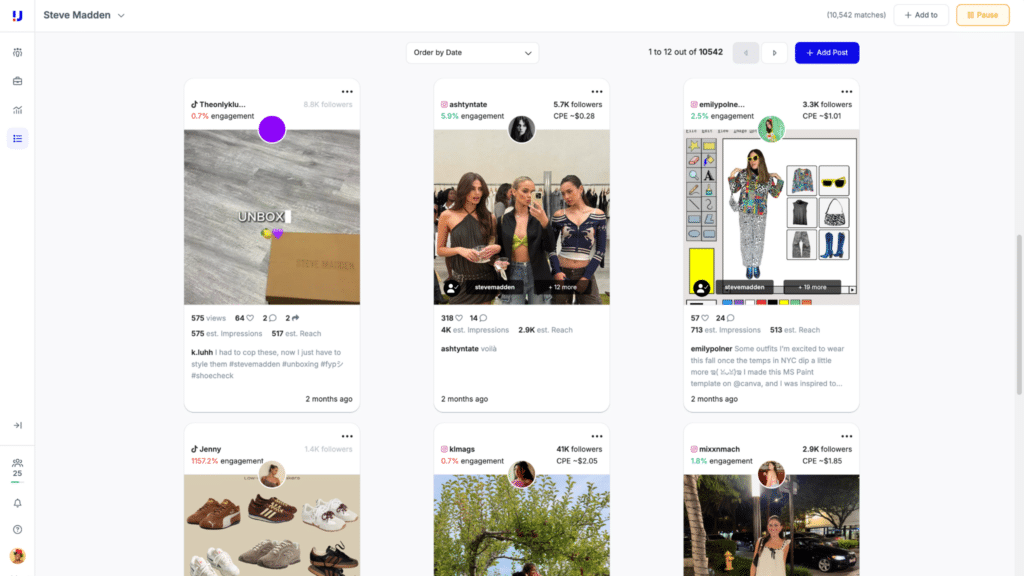
Image: Upfluence content monitoring
The Real Risk of AI in Creator Marketing Is to Social Platforms
Jaice’s expansion of automation sits alongside a trend Kevin describes as a harder problem for social media platforms: AI-generated content filling feeds at the expense of creator-audience relationships. “I wonder if the value of authentic creators, who are not loved just for their content but for them as people, their values, who they are, that parasocial attachment built between them and their audience, is going to be the real value a creator has at the end of the day,” he says.
His view is that platforms built on creator trust will face pressure to defend it structurally. YouTube is, in his view, the only platform currently doing so. It shares revenue with creators and has proactively demonetized AI content farms. Vivien agrees the problem remains unresolved. “Even on YouTube where it’s no longer monetized, you still see a plethora of AI content,” he says. “They’re going to have to make tough decisions.”
For a platform whose product reduces the labor behind creator campaigns, the concern is directed at what occupies feeds, not at the logistics of running them. Jaice handles administration. The creative output and community relationships that make creators commercially valuable remain, in both Kevin and Vivien’s framing, irreducibly human.
The Next Step May Be Brand Agent Meets Creator Agent
Vivien expects Upfluence to build a version of Jaice for the creator side of the marketplace. The vision is a brand’s AI and a creator’s AI handling contracting and negotiation between them, removing email management from the creator’s workflow entirely. “A lot of them actually don’t do it,” Vivien says, referring to the administrative work of managing brand outreach.
“That’s putting a bit of a hindrance on their growth and their earning potential. This is going to create a bit of a gold rush for creators who hit a plateau because they didn’t want to put in the work to reach out to brands themselves,” he says.
Kevin frames the broader shift as an open question. Influencer Marketing grew substantially, he argues, despite being operationally difficult to run. The agentic platform removes much of that difficulty. “The industry grew so much despite being so complicated,” Kevin says. “Now that this is going to be so simple, what is the next step? How is it going to change an industry that was growing despite its weaknesses, and now you remove the weaknesses?”
Subscribe to Our Newsletter
Check Out Our Podcast