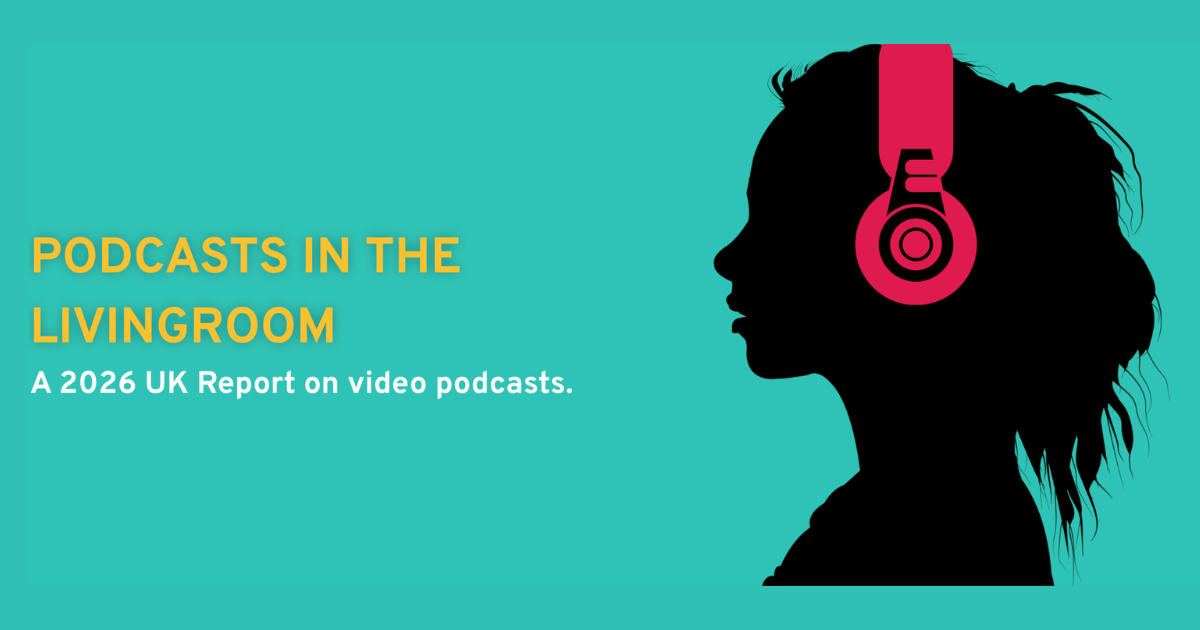
A new survey from Signal Hill Insights and FlightStory finds that smart televisions have become the second most-used device for podcast consumption in the United Kingdom, as video podcast viewing closes the gap on traditional audio listening.
The “Podcasts in the Living Room” Pulse Report, based on a nationally representative survey of 1,003 monthly podcast consumers aged 18 and older conducted March 3-9, 2026, tracks how and when UK audiences engage with video podcasts and which devices they use.
Video Watching Closes Gap on Audio Listening
The survey found that 84% of monthly podcast consumers watched a podcast in the past month, compared with 90% who listened to one. Younger audiences led video consumption, with 92% of those aged 18 to 34 reporting they watched a podcast in the last month, followed by 86% of those aged 35 to 54 and 75% of consumers aged 55 and older.
Despite the growth of video formats, the report found no evidence that video podcasts are displacing audio consumption. When survey respondents were asked what activity video podcast watching replaced, 55% said television and movies, 44% cited social media scrolling and social video excluding YouTube, and 35% said music listening. Only 15% said it replaced audio podcast listening.
Smart TVs Rank Second Among Podcast Devices
Smartphones remain the leading podcast device, used by 80% of monthly consumers in the past month. Smart TVs ranked second at 45%, ahead of computers and tablets, which each registered 44%. Among consumers aged 18 to 34, smart TV usage for podcasts reached 64% in the past month.
Smart TVs account for just over half, 52%, of all podcast watch time. The report also found that 42% of smart TV podcast watching occurs with at least one other person present, a co-viewing behavior the report notes can multiply audience reach for a given piece of content.
The report found that smart TVs are also used for audio-only podcast listening, with 21% of monthly consumers having listened to a podcast on a smart TV in the past month, compared with 83% who listened on a smartphone.
Primetime Viewing Patterns Differ From Listening
Time-of-day patterns diverge between watching and listening. Fifty-four percent of consumers watch video podcasts during weekday evening hours, defined as 7 p.m. to 11 p.m., making that the most concentrated window for video consumption. Audio listening, by contrast, is distributed more evenly across the day, with morning and commute hours drawing 29% of listeners compared with 13% for video watchers during the same window.
Consumers Rate Smart TV Experience Above Smartphone
Among consumers who have watched podcasts on a smart TV, perception of the experience relative to smartphone viewing was broadly favorable. Thirty-six percent described the smart TV experience as more premium, and 43% called it more engaging or more convenient. Fewer than 10% said it was less engaging, less convenient, or inferior to smartphone viewing. Only 8% said the experience was about the same.
Among on-screen visual elements, consumers rated seeing hosts and guests interact as the most valuable, followed by seeing the subjects being discussed, set design quality, on-screen graphics and text, and production sophistication.
Non-Users Show Openness to Smart TV Podcasts
Among consumers who do not currently use smart TVs for podcasts, half said they were somewhat or very interested in trying it. Only 27% said they were not very or not at all interested. Three in ten audio-only consumers also reported interest in using a smart TV for podcasts in the future. The most frequently cited reason for not using smart TVs for podcasts, selected by 36% of non-users, was a general preference against watching television for podcast content.
Signal Hill Insights conducted the research in partnership with FlightStory using a nationally representative panel. The survey targeted adults 18 and older who consume podcasts at least monthly in the UK.
Image source: Signal Hill Insights, FlightStory Get the full report here
Dragomir is a Serbian freelance blog writer and translator. He is passionate about covering insightful stories and exploring topics such as influencer marketing, the creator economy, technology, business, and cyber fraud.











A new survey from Signal Hill Insights and FlightStory finds that smart televisions have become the second most-used device for podcast consumption in the United Kingdom, as video podcast viewing closes the gap on traditional audio listening.
The “Podcasts in the Living Room” Pulse Report, based on a nationally representative survey of 1,003 monthly podcast consumers aged 18 and older conducted March 3-9, 2026, tracks how and when UK audiences engage with video podcasts and which devices they use.
Video Watching Closes Gap on Audio Listening
The survey found that 84% of monthly podcast consumers watched a podcast in the past month, compared with 90% who listened to one. Younger audiences led video consumption, with 92% of those aged 18 to 34 reporting they watched a podcast in the last month, followed by 86% of those aged 35 to 54 and 75% of consumers aged 55 and older.
Despite the growth of video formats, the report found no evidence that video podcasts are displacing audio consumption. When survey respondents were asked what activity video podcast watching replaced, 55% said television and movies, 44% cited social media scrolling and social video excluding YouTube, and 35% said music listening. Only 15% said it replaced audio podcast listening.
Smart TVs Rank Second Among Podcast Devices
Smartphones remain the leading podcast device, used by 80% of monthly consumers in the past month. Smart TVs ranked second at 45%, ahead of computers and tablets, which each registered 44%. Among consumers aged 18 to 34, smart TV usage for podcasts reached 64% in the past month.
Smart TVs account for just over half, 52%, of all podcast watch time. The report also found that 42% of smart TV podcast watching occurs with at least one other person present, a co-viewing behavior the report notes can multiply audience reach for a given piece of content.
The report found that smart TVs are also used for audio-only podcast listening, with 21% of monthly consumers having listened to a podcast on a smart TV in the past month, compared with 83% who listened on a smartphone.
Primetime Viewing Patterns Differ From Listening
Time-of-day patterns diverge between watching and listening. Fifty-four percent of consumers watch video podcasts during weekday evening hours, defined as 7 p.m. to 11 p.m., making that the most concentrated window for video consumption. Audio listening, by contrast, is distributed more evenly across the day, with morning and commute hours drawing 29% of listeners compared with 13% for video watchers during the same window.
Consumers Rate Smart TV Experience Above Smartphone
Among consumers who have watched podcasts on a smart TV, perception of the experience relative to smartphone viewing was broadly favorable. Thirty-six percent described the smart TV experience as more premium, and 43% called it more engaging or more convenient. Fewer than 10% said it was less engaging, less convenient, or inferior to smartphone viewing. Only 8% said the experience was about the same.
Among on-screen visual elements, consumers rated seeing hosts and guests interact as the most valuable, followed by seeing the subjects being discussed, set design quality, on-screen graphics and text, and production sophistication.
Non-Users Show Openness to Smart TV Podcasts
Among consumers who do not currently use smart TVs for podcasts, half said they were somewhat or very interested in trying it. Only 27% said they were not very or not at all interested. Three in ten audio-only consumers also reported interest in using a smart TV for podcasts in the future. The most frequently cited reason for not using smart TVs for podcasts, selected by 36% of non-users, was a general preference against watching television for podcast content.
Signal Hill Insights conducted the research in partnership with FlightStory using a nationally representative panel. The survey targeted adults 18 and older who consume podcasts at least monthly in the UK.
Image source: Signal Hill Insights, FlightStory
Get the full report here
Subscribe to Our Newsletter
Check Out Our Podcast