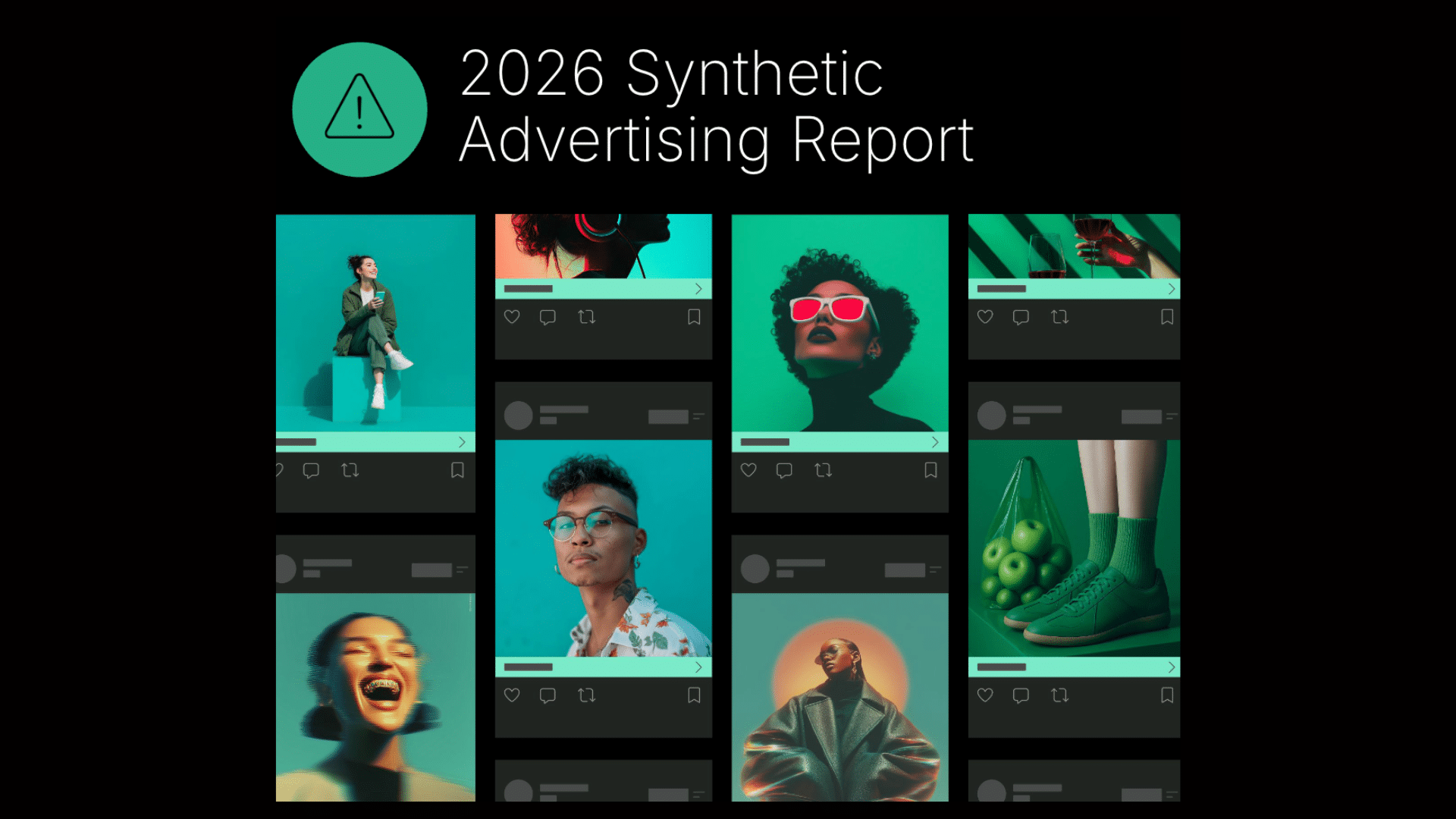
A new report from Resemble AI, a synthetic media detection company, has found that AI-generated or manipulated content appeared in roughly 1 in 11 ad files running on Meta’s platforms, and that advertisers disclosed AI use in the ad copy in just 0.06% of flagged files.
The study ran Resemble’s Detect tool across 37,768 image and video files from 15,433 ads, spanning 509 companies in 26 industries, pulled from Meta’s public Ad Library in September 2026. Detect flagged 3,379 files, or 8.9%, as AI-generated or manipulated. On the subset of 28,463 files that brands ran from their own pages, the rate was 6.9%, or 1,971 files. Across those brand pages, 222 of 389 companies, or 57%, ran at least one AI-flagged ad.
Use Was Concentrated, Not Universal
Use varied widely by brand. Resemble found 167 of the 389 brands ran no AI-flagged ads at all, while 13 brands used AI in more than 40% of their sampled ads. Among brands that ran two or more AI ads, the average share of AI content was 12.5%. Resemble named Temu (64 of 100 files), Wayfair (56 of 100), Motel 6 (50 of 80), and Lufthansa (50 of 94) as running AI in more than half of their sampled ads.
The report also matched 313 parent companies to employee and marketing headcount data from Apollo and found no relationship between company size and AI use: rates held between roughly 6 and 9% regardless of total employees or marketing staff. Resemble pointed to Temu, which it said runs a $54 billion business with 232 marketers and used AI in 64 of 100 ads, against Amazon, which it said has nearly 23,000 marketers and used none in the sample.
Consumer Goods Led, Regulated Industries Lagged
AI rates by industry ranged from 13.4% in consumer packaged goods, the highest of the 26 categories, to 2.4% in quick-service restaurants, the lowest. Consumer electronics (12.6%) and fintech and crypto (11.2%) followed. Regulated categories sat at the bottom: banking and financial services at 3.8%, nonprofits at 3.3% and pharmaceuticals at 2.8%.
Bait Pages Used AI at Far Higher Rates Than Brands
Searching each brand’s name in the Ad Library also surfaced 649 files from pages Resemble classified as “bait pages,” meaning pages using a brand’s name without being run by the brand. Resemble found 71.3% of these files were AI-generated, more than ten times the 6.9% rate on brand-run pages. These bait pages accounted for about 2% of all files scanned but 14% of all flagged fakes, and Resemble said three in four of those fakes were clickbait advertorials.
Disclosure and Provenance Were Nearly Absent
Resemble searched the copy of every ad for any mention of AI generation and checked 971 files for C2PA content credentials, the industry’s provenance standard. Only 2 of 3,379 AI-flagged files, or 0.06%, disclosed AI use in the ad copy, and Resemble said Turkish Airlines was the only brand to do so, noting in a caption that visuals in an International Cat Day video were “created using artificial intelligence technology.” None of the 971 files checked carried C2PA credentials, including every confirmed fake.
Betting and Crypto Ads Were the Most Synthetic, Largely on Audio
Resemble added a separate scan of nine prediction market, sportsbook and crypto brands, checking audio as well as visuals. It found 142 of 900 brand-page files, or 15.8%, were AI-generated, close to double the study’s overall average, with crypto and brokerage brands driving most of it at 29.3%. OKX topped the group at 48.5%. Of 67 audio fakes identified in this collection, 57 were synthetic voices, and Resemble traced 55 of those to ElevenLabs; 54 of the 57 synthetic voices played over video that Detect rated as authentic footage.
The report also described an incident involving YouTuber Elliot Choy, who identified a Kalshi ad built from his 2025 apartment-move video with the same script, room and framing, but with his body replaced by a white man who does not exist. Resemble’s scan rated the ad AI-generated with a 0.90 score. Kalshi told NPR the ad was old, that it no longer runs AI-generated ads, and that it was reviewing its relationship with the agency that produced it. Resemble noted creator Pushpek Sidhu reported a similar incident involving a betting ad in June.
The report also surveyed disclosure requirements across jurisdictions, noting that South Korea, New York state, China and India have rules in force requiring labeling of AI-generated figures or content in ads, while the U.S. federal government currently relies on general FTC deception rules, with the NO FAKES Act still pending.
Image source: Resemble.ai The full report can be foundhere
Dragomir is a Serbian freelance blog writer and translator. He is passionate about covering insightful stories and exploring topics such as influencer marketing, the creator economy, technology, business, and cyber fraud.















A new report from Resemble AI, a synthetic media detection company, has found that AI-generated or manipulated content appeared in roughly 1 in 11 ad files running on Meta’s platforms, and that advertisers disclosed AI use in the ad copy in just 0.06% of flagged files.
The study ran Resemble’s Detect tool across 37,768 image and video files from 15,433 ads, spanning 509 companies in 26 industries, pulled from Meta’s public Ad Library in September 2026. Detect flagged 3,379 files, or 8.9%, as AI-generated or manipulated. On the subset of 28,463 files that brands ran from their own pages, the rate was 6.9%, or 1,971 files. Across those brand pages, 222 of 389 companies, or 57%, ran at least one AI-flagged ad.
Use Was Concentrated, Not Universal
Use varied widely by brand. Resemble found 167 of the 389 brands ran no AI-flagged ads at all, while 13 brands used AI in more than 40% of their sampled ads. Among brands that ran two or more AI ads, the average share of AI content was 12.5%. Resemble named Temu (64 of 100 files), Wayfair (56 of 100), Motel 6 (50 of 80), and Lufthansa (50 of 94) as running AI in more than half of their sampled ads.
The report also matched 313 parent companies to employee and marketing headcount data from Apollo and found no relationship between company size and AI use: rates held between roughly 6 and 9% regardless of total employees or marketing staff. Resemble pointed to Temu, which it said runs a $54 billion business with 232 marketers and used AI in 64 of 100 ads, against Amazon, which it said has nearly 23,000 marketers and used none in the sample.
Consumer Goods Led, Regulated Industries Lagged
AI rates by industry ranged from 13.4% in consumer packaged goods, the highest of the 26 categories, to 2.4% in quick-service restaurants, the lowest. Consumer electronics (12.6%) and fintech and crypto (11.2%) followed. Regulated categories sat at the bottom: banking and financial services at 3.8%, nonprofits at 3.3% and pharmaceuticals at 2.8%.
Bait Pages Used AI at Far Higher Rates Than Brands
Searching each brand’s name in the Ad Library also surfaced 649 files from pages Resemble classified as “bait pages,” meaning pages using a brand’s name without being run by the brand. Resemble found 71.3% of these files were AI-generated, more than ten times the 6.9% rate on brand-run pages. These bait pages accounted for about 2% of all files scanned but 14% of all flagged fakes, and Resemble said three in four of those fakes were clickbait advertorials.
Disclosure and Provenance Were Nearly Absent
Resemble searched the copy of every ad for any mention of AI generation and checked 971 files for C2PA content credentials, the industry’s provenance standard. Only 2 of 3,379 AI-flagged files, or 0.06%, disclosed AI use in the ad copy, and Resemble said Turkish Airlines was the only brand to do so, noting in a caption that visuals in an International Cat Day video were “created using artificial intelligence technology.” None of the 971 files checked carried C2PA credentials, including every confirmed fake.
Betting and Crypto Ads Were the Most Synthetic, Largely on Audio
Resemble added a separate scan of nine prediction market, sportsbook and crypto brands, checking audio as well as visuals. It found 142 of 900 brand-page files, or 15.8%, were AI-generated, close to double the study’s overall average, with crypto and brokerage brands driving most of it at 29.3%. OKX topped the group at 48.5%. Of 67 audio fakes identified in this collection, 57 were synthetic voices, and Resemble traced 55 of those to ElevenLabs; 54 of the 57 synthetic voices played over video that Detect rated as authentic footage.
The report also described an incident involving YouTuber Elliot Choy, who identified a Kalshi ad built from his 2025 apartment-move video with the same script, room and framing, but with his body replaced by a white man who does not exist. Resemble’s scan rated the ad AI-generated with a 0.90 score. Kalshi told NPR the ad was old, that it no longer runs AI-generated ads, and that it was reviewing its relationship with the agency that produced it. Resemble noted creator Pushpek Sidhu reported a similar incident involving a betting ad in June.
The report also surveyed disclosure requirements across jurisdictions, noting that South Korea, New York state, China and India have rules in force requiring labeling of AI-generated figures or content in ads, while the U.S. federal government currently relies on general FTC deception rules, with the NO FAKES Act still pending.
Image source: Resemble.ai
The full report can be found here
Subscribe to Our Newsletter
Check Out Our Podcast