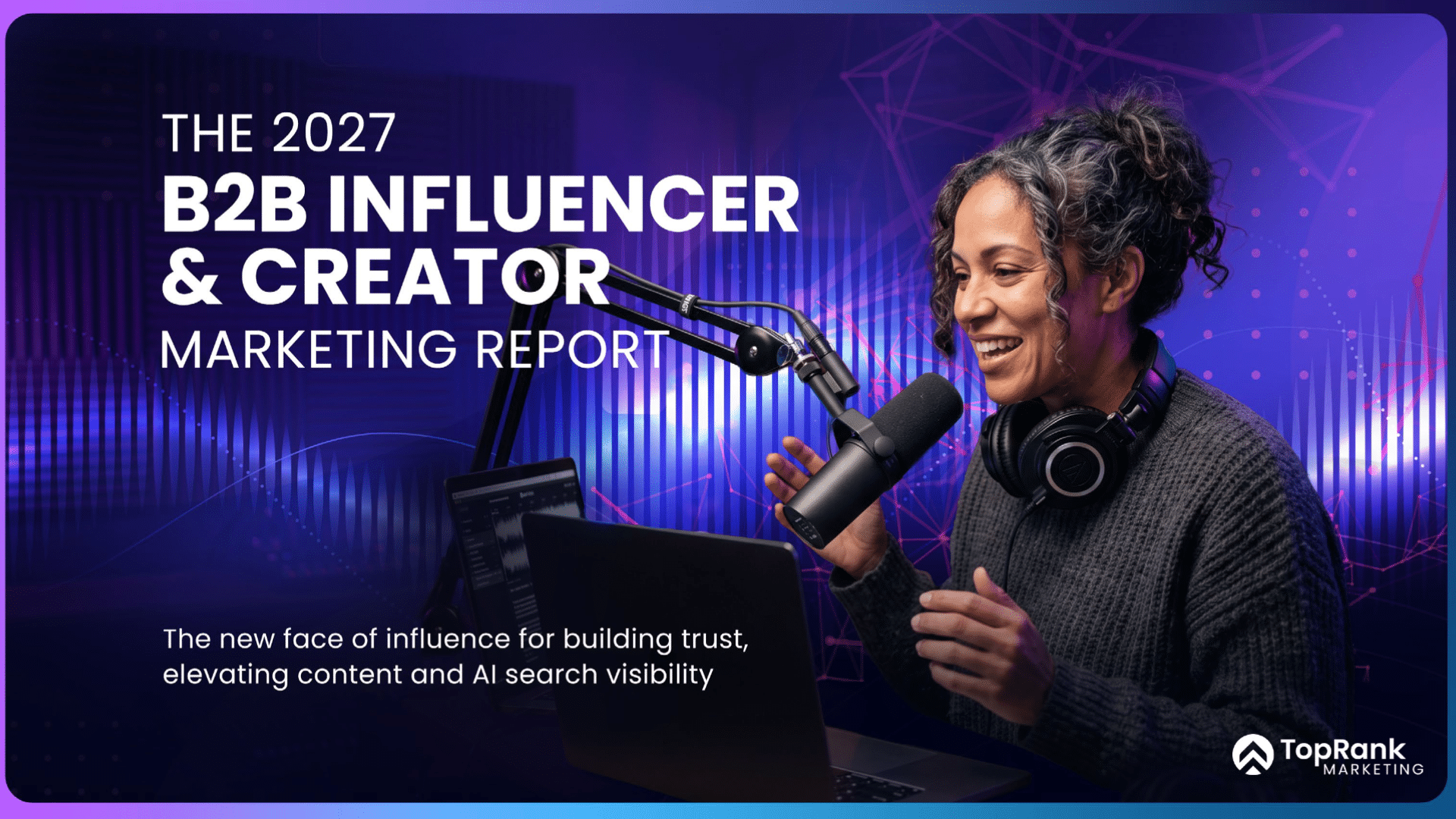
B2B buyers now ask AI chatbots for shortlists before they ever visit a vendor’s website, but 96% of B2B companies are largely invisible in that early-stage AI discovery, according to the “2026 2X AI Visibility Index” cited in TopRank Marketing’s fifth annual “B2B Influencer & Creator Marketing Report.”
The report, produced with research partner Ascend2 from a survey of 424 qualified B2B marketers, finds that answer engines routinely skip brand-owned content and cite trusted third-party voices instead, including influential creators.
The disconnect extends to how buyers search in the first place. Per G2 research cited in the report, 51% of buyers now start their research with an AI chatbot more often than with Google. Bain & Company data in the report found that 89% of citations for unbranded prompts come from third-party sources rather than brand-owned content. Separately, Ahrefs’ analysis of AI Overview visibility factors across 75,000 brands found that brand web mentions correlate with AI citation rates roughly three times more strongly than backlinks do, according to figures cited in the report.
Awareness Outpaces Action
TopRank Marketing’s own survey data shows B2B marketers recognize the shift without fully acting on it. Eighty-six percent rated improving AI and generative-AI visibility as at least moderately important this year, with 53% calling it very important. Yet only 21% have made AI/LLM visibility a primary goal of their influencer program, and just 37% have integrated Influencer Marketing with AI search optimization, commonly referred to as answer engine optimization or generative engine optimization (AEO/GEO).
That integration gap was the widest divide the report found between programs rated very effective and all others: 49% of programs rated “very effective” have integrated AEO/GEO into their strategy, compared with 27% of all others, a 22-point spread TopRank Marketing characterizes as the clearest current differentiator among B2B influencer programs. Among organizations that do connect Influencer Marketing to AI search tracking, 48% report their brand gets cited in AI-generated answers, versus 26% of those that haven’t made the connection. The report states that B2B brands integrating Influencer Marketing with AI search are nearly twice as likely to be cited by AI.
Programs Are Maturing, But Unevenly
The report found B2B Influencer Marketing has become mainstream: 83% of surveyed marketers either run a program, are building one, or plan to launch one within a year. Ninety-three percent of those with active programs rate them effective, and 46% call them very effective. Program maturity still scales heavily with company size, with full strategy documentation climbing from 24% at companies under 250 employees to 65% at companies with 10,000 or more employees, and always-on adoption rising from 31% to 53%-57% over the same range.
Documentation and consistency separated top performers most sharply. Programs rated very effective were roughly three times more likely to run an always-on strategy than all other programs (72% versus 27%) and three times more likely to have a fully documented strategy (73% versus 22%). Always-on programs attributed nearly double the revenue to their influencer efforts compared with campaign-based programs, 42% versus 24%, according to the survey.
Compensation and Creator Selection
The report also tracked how B2B brands compensate and select creators. Pay-per-deliverable arrangements were the most common compensation model this year at 51%, edging out performance-based pay at 48% and reversing last year’s ranking, in which performance-based compensation led. Twenty-two percent of respondents said they are not currently compensating influencers at all.
On selection criteria, B2B marketers continued to prioritize trust over audience size: 46% cited trustworthiness and credibility as a selection factor, compared with 30% citing size of audience or network. Very effective programs were nearly twice as likely as others to partner with entertainment creators, 43% versus 25%, which TopRank Marketing frames as a sign of B2B’s growing openness to less conventional creator profiles.
Measurement Gaps Persist
Ninety-two percent of marketers said they feel at least somewhat confident justifying influencer budget to a CFO, though only 52% feel very confident. The report found a disconnect between what gets reported to leadership and what executives say they value: brand awareness (54%) and engagement (47%) dominate leadership reporting, while revenue attribution (38%) and pipeline influence (25%) rank lower despite being the metrics C-suite respondents say they prioritize.
The survey was fielded from mid-May to mid-June 2026 among 424 qualified B2B marketing professionals in manager-level roles or above at U.S. companies with 100 or more employees.
Image source: “The 2027 B2B Influencer & Creator Marketing Report” The full report is availablehere
Dragomir is a Serbian freelance blog writer and translator. He is passionate about covering insightful stories and exploring topics such as influencer marketing, the creator economy, technology, business, and cyber fraud.









B2B buyers now ask AI chatbots for shortlists before they ever visit a vendor’s website, but 96% of B2B companies are largely invisible in that early-stage AI discovery, according to the “2026 2X AI Visibility Index” cited in TopRank Marketing’s fifth annual “B2B Influencer & Creator Marketing Report.”
The report, produced with research partner Ascend2 from a survey of 424 qualified B2B marketers, finds that answer engines routinely skip brand-owned content and cite trusted third-party voices instead, including influential creators.
The disconnect extends to how buyers search in the first place. Per G2 research cited in the report, 51% of buyers now start their research with an AI chatbot more often than with Google. Bain & Company data in the report found that 89% of citations for unbranded prompts come from third-party sources rather than brand-owned content. Separately, Ahrefs’ analysis of AI Overview visibility factors across 75,000 brands found that brand web mentions correlate with AI citation rates roughly three times more strongly than backlinks do, according to figures cited in the report.
Awareness Outpaces Action
TopRank Marketing’s own survey data shows B2B marketers recognize the shift without fully acting on it. Eighty-six percent rated improving AI and generative-AI visibility as at least moderately important this year, with 53% calling it very important. Yet only 21% have made AI/LLM visibility a primary goal of their influencer program, and just 37% have integrated Influencer Marketing with AI search optimization, commonly referred to as answer engine optimization or generative engine optimization (AEO/GEO).
That integration gap was the widest divide the report found between programs rated very effective and all others: 49% of programs rated “very effective” have integrated AEO/GEO into their strategy, compared with 27% of all others, a 22-point spread TopRank Marketing characterizes as the clearest current differentiator among B2B influencer programs. Among organizations that do connect Influencer Marketing to AI search tracking, 48% report their brand gets cited in AI-generated answers, versus 26% of those that haven’t made the connection. The report states that B2B brands integrating Influencer Marketing with AI search are nearly twice as likely to be cited by AI.
Programs Are Maturing, But Unevenly
The report found B2B Influencer Marketing has become mainstream: 83% of surveyed marketers either run a program, are building one, or plan to launch one within a year. Ninety-three percent of those with active programs rate them effective, and 46% call them very effective. Program maturity still scales heavily with company size, with full strategy documentation climbing from 24% at companies under 250 employees to 65% at companies with 10,000 or more employees, and always-on adoption rising from 31% to 53%-57% over the same range.
Documentation and consistency separated top performers most sharply. Programs rated very effective were roughly three times more likely to run an always-on strategy than all other programs (72% versus 27%) and three times more likely to have a fully documented strategy (73% versus 22%). Always-on programs attributed nearly double the revenue to their influencer efforts compared with campaign-based programs, 42% versus 24%, according to the survey.
Compensation and Creator Selection
The report also tracked how B2B brands compensate and select creators. Pay-per-deliverable arrangements were the most common compensation model this year at 51%, edging out performance-based pay at 48% and reversing last year’s ranking, in which performance-based compensation led. Twenty-two percent of respondents said they are not currently compensating influencers at all.
On selection criteria, B2B marketers continued to prioritize trust over audience size: 46% cited trustworthiness and credibility as a selection factor, compared with 30% citing size of audience or network. Very effective programs were nearly twice as likely as others to partner with entertainment creators, 43% versus 25%, which TopRank Marketing frames as a sign of B2B’s growing openness to less conventional creator profiles.
Measurement Gaps Persist
Ninety-two percent of marketers said they feel at least somewhat confident justifying influencer budget to a CFO, though only 52% feel very confident. The report found a disconnect between what gets reported to leadership and what executives say they value: brand awareness (54%) and engagement (47%) dominate leadership reporting, while revenue attribution (38%) and pipeline influence (25%) rank lower despite being the metrics C-suite respondents say they prioritize.
The survey was fielded from mid-May to mid-June 2026 among 424 qualified B2B marketing professionals in manager-level roles or above at U.S. companies with 100 or more employees.
Image source: “The 2027 B2B Influencer & Creator Marketing Report”
The full report is available here
Subscribe to Our Newsletter
Check Out Our Podcast