
Technology
Organic Sephora Sale Hauls Show Whether Beauty Marketing Is Working, According to Plot Research

Plot‘s research agent watched 19,130 TikTok and Instagram posts about Sephora’s fall Savings Event and kept 15,920 that were about the sale itself. Megan Duong Trivedi, Plot’s co-founder and CEO, says most were hauls that shoppers filmed unprompted, and she reads what they recommended as the test of whether a beauty brand’s marketing is working.
“If you’re a beauty brand, the way to go to market and sell is to be on social,” Megan says. “If you make it in the top recommendations, then your marketing is actually effective.” The difficulty is seeing those recommendations at all, since a creator filming a get-ready video might use 20 products and tag none of them.
Plot, which Megan co-founded in New York in 2022, sells brand social and community teams a view into that untagged activity. Its AI agents scan social video for who uses a product, how they apply it and how they describe it, whether or not the brand is tagged. “Think of us as your AI agent that’s watching several millions of social videos every day,” Megan explains.
The idea came from her career in social and brand marketing, which ran through Gap and Apple before she launched a social media agency in 2020, just as feeds turned to video and she saw an untapped opportunity in analyzing it. The Sephora report took the team about a day to build on Plot’s platform, according to Megan, and ranks brands and products by how many sale posts showed them.
Mention Counts Outweigh a Single Viral Video
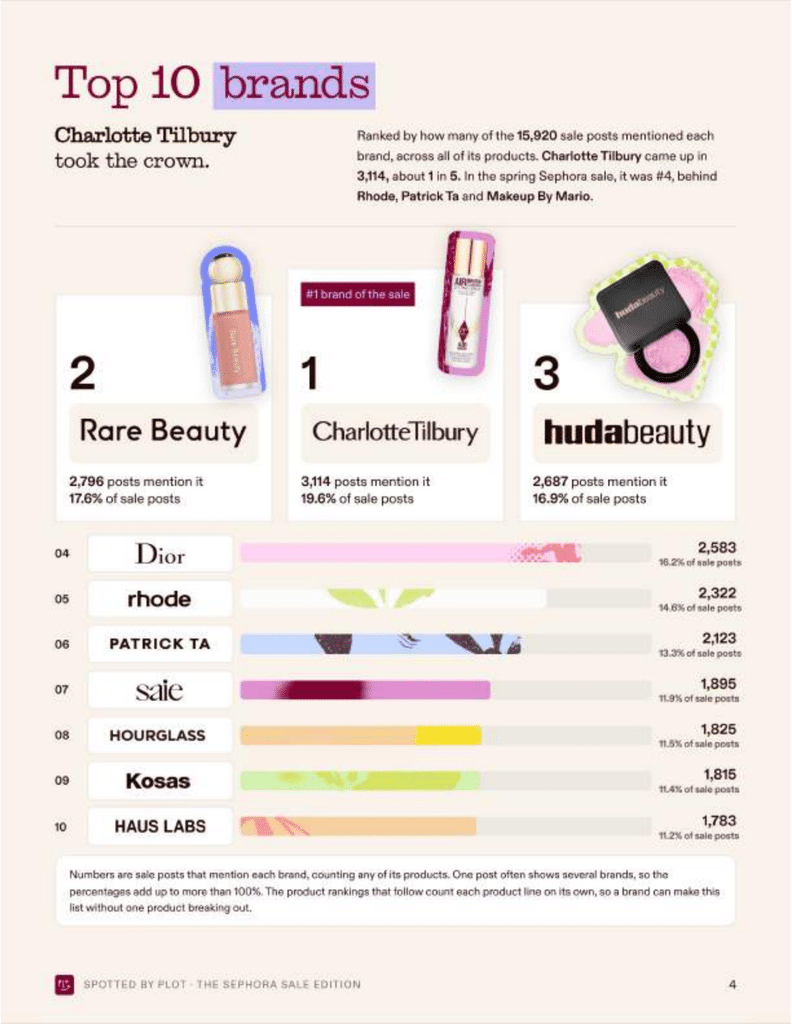
Ranking by post count put Charlotte Tilbury first this fall, in 3,114 sale posts or about one in five, after a fourth-place finish in spring behind Rhode, Patrick Ta and Makeup by Mario. Megan does not claim to know what lifted Charlotte Tilbury. “I’m a data observer. I’m not necessarily a makeup expert,” she says, noting only that its setting spray is an everyday product people need year-round.
What the method does capture is breadth. Megan recently asked Nanette Wong, Fenty Beauty’s VP of Marketing, whether she valued mentions or a single viral hit more, and Nanette chose mentions because they reflect how many creators actually recommend the product. “The more creators who are posting about your product, there’s a good chance somebody will see it because it’s a volume game,” Megan argues.
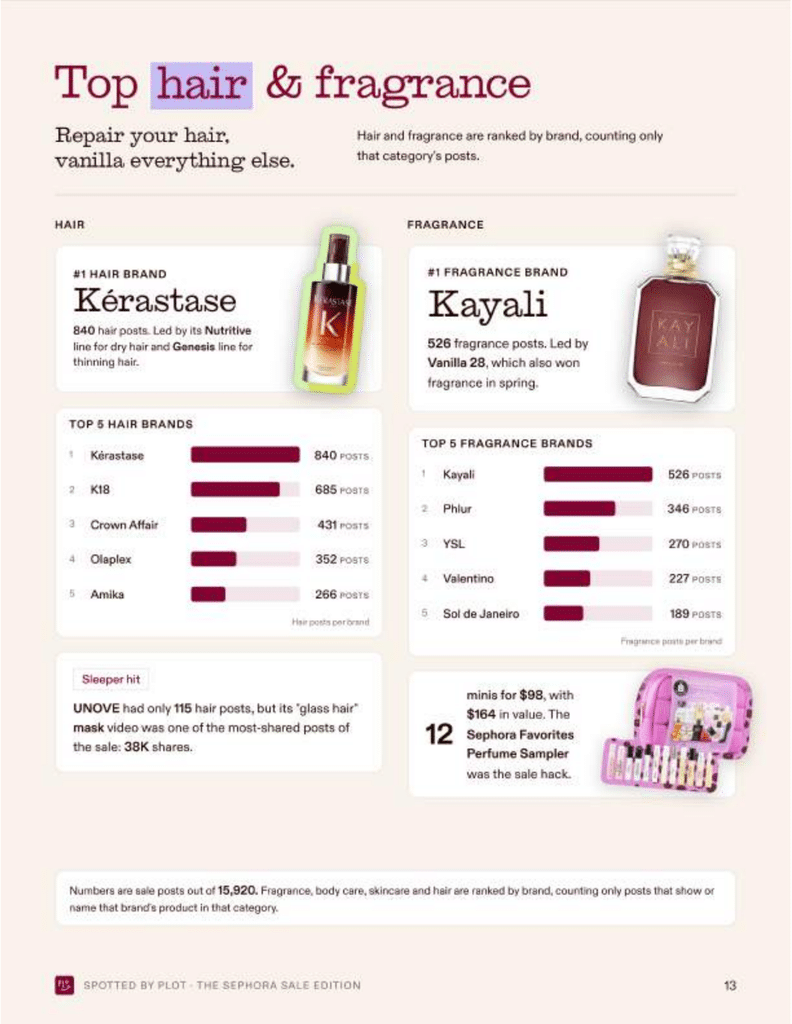
The report holds a test case. UNOVE appeared in only 115 hair posts, yet one of its “glass hair” mask videos drew 38,000 shares, among the most-shared posts of the sale. Megan says brands still want large creators with distribution. In the Fenty view she relays, though, one video cannot always move sales, while a high volume of recommendations carries more weight.
A brand total, however, folds every product into one number. The product rankings show how shoppers actually built their carts.
Shoppers Mix Brands, So Hero Products Surface
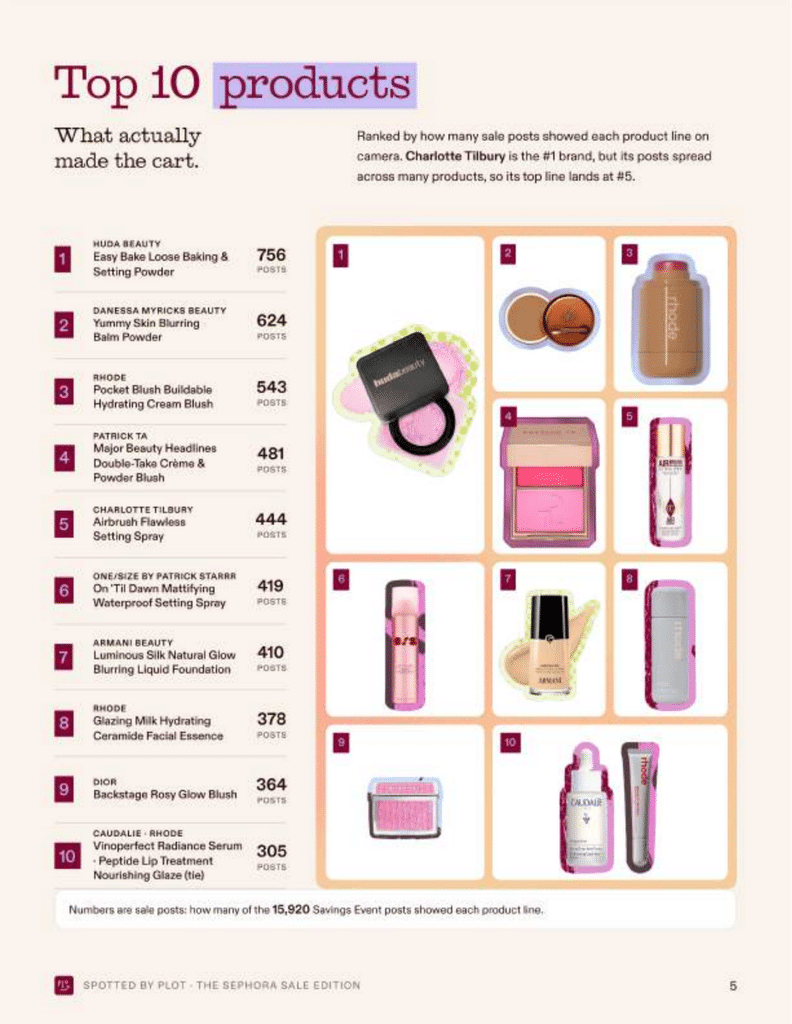
Charlotte Tilbury’s lead was spread across its catalog. Its top line, Airbrush Flawless Setting Spray, ranked fifth among products at 444 posts, while Huda Beauty’s Easy Bake Loose Baking & Setting Powder was the most-shown product of the sale at 756.
The videos are consumer hauls, and Megan sees no sign of brands pushing full lineups in them. “We don’t buy all the products from one brand,” she observes. “You take different pieces to try.”
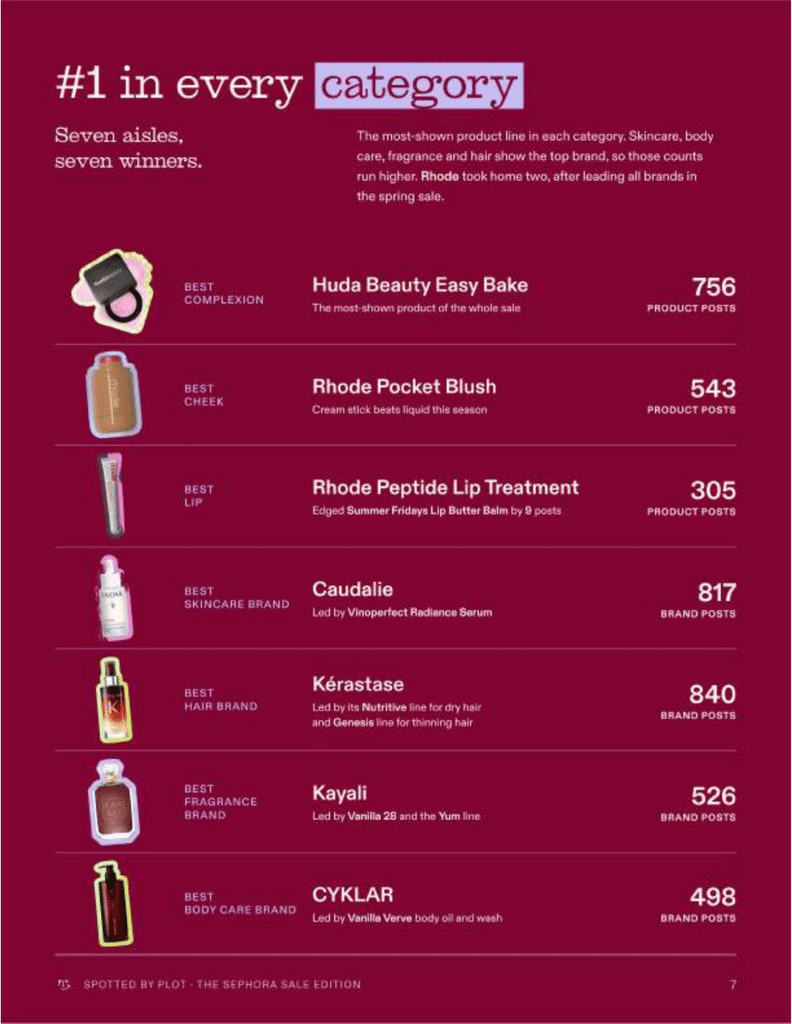
Single products can still break out of that mix. Rhode won two of the report’s seven categories with one product each, Pocket Blush in cheek (543 posts) and Peptide Lip Treatment in lip (305).
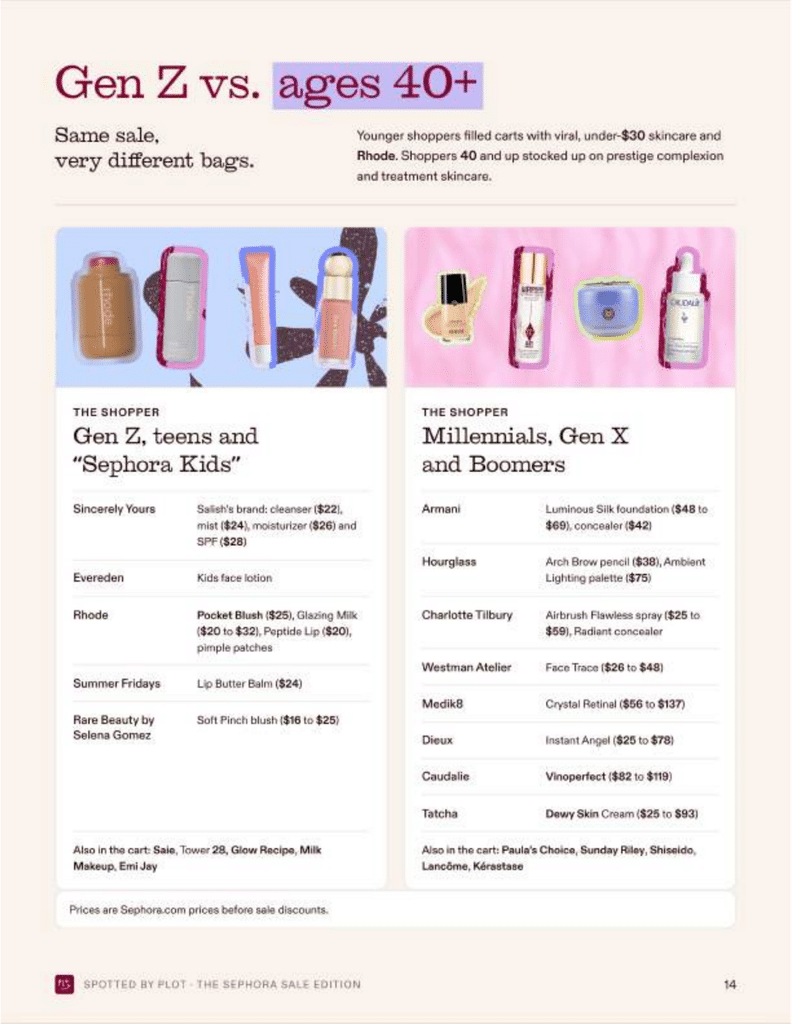
Carts also split by age. Shoppers 40 and up stocked up on prestige complexion and skincare such as Armani’s Luminous Silk foundation, listed at $48 to $69 before discounts, while Gen Z leaned on Rhode, Summer Fridays and Rare Beauty. “As you get older, you have more disposable income, and you care more about your skin,” Megan says.
Brands Leave the Hook to Creators
The format of those hauls belonged to the shoppers. Two of the most-liked posts in Plot’s data were a $995 receipt and a silent ride home after a $1,700 haul. Megan puts their performance down to shock, given what she estimates is a typical $200 to $300 restock. “Anything that’s kind of polarizing from a content perspective tends to just get more views and likes,” she says.
Brands increasingly leave that choice to creators. In Megan’s experience, briefs now cover the product, its benefits and its positioning, while the hook and execution stay with the creator. She traces the shift to the first wave of Influencer Marketing, when brands scripted creators like commercial ads. “You partner with the creator because they create good content,” she argues. “The creator knows the audience the best.”
Under that model, a brand gets the shock-value haul by picking a creator who already makes them. “If the creator is known to create these polarizing conversations, then that might actually be their strategy,” Megan notes. The timing of organic posts sits even further outside a brand’s control.
Brands Set the Clock Before the Sale Opens
About two-thirds of sale-related content arrived in the first eight days of Plot’s monitoring period, which ran Oct. 27 to Nov. 9, according to the company’s data. Megan attributes the front-loading to fear of sellouts. “There’s always way more volume in the beginning of sale because people get worried that things will actually run out of stock,” she says.
Very few of the sale posts were paid, according to Megan, so brands could not schedule them. “I’m going to post tomorrow about Sephora sale. It’s not like Sephora told me to do it,” she points out.
Brands can act in the run-up. Megan cites a launch pattern from a year or two ago, though she does not know how well it performed. Patrick Ta, she recalls, released new products just before the sale, drew press when buyers complained about the prices, explained them, and let the discount close the sale. “Drop the product before, get people to organically post about it probably the months prior, get people to test it,” she advises.
The friction she has in mind is price, the “I hate it, but I’m gonna buy” reaction to an expensive product that works. “You don’t need to be a controversial founder to be polarizing,” Megan says. Launches timed that way add to the count, which still has to be read.
A Post Count Still Needs a Second Read
Kérastase led hair with 840 posts, and some hair content in the sale told viewers to swap it for cheaper drugstore products. “You have to read through the sentiment,” Megan says. The report presents totals, she explains, and brands then use Plot’s agents to see what the posts said. “It could be only a few were ‘save your money’ type of thing, but it could also be overwhelmingly positive.”
Real shoppers are harder to verify. Plot cannot tell whether a video is AI-generated UGC, Megan says, though it can filter out accounts that look fake, such as a profile with a couple of followers posting 100 times on the same theme. “That’s a really hard problem to solve because people are using other people’s likeness,” she says.
The rankings, then, depend on choices about what to exclude. “You have to make those assumptions,” Megan notes. Valuation follows stated rules too. Plot’s earned media value calculation weights saves more heavily as a sign of high intent, and that weighting is what she would walk a skeptical CFO through.
Brands Will Keep Partnering With Real Creators
The screening problem feeds into Megan’s outlook. She expects brands to keep partnering with real people and doubts any will want AI-made UGC creators, because fans want to follow creators’ lives and meet them in person. Her own shopping points the same way. “I don’t follow celebrities,” she explains. “I care about people who are in similar interest to me.”
The fall data is built on that behavior, with brands ranked by how often shoppers, mostly unpaid, put them on camera. Plot’s bet is that brands will need to read that activity faster than any team of people could.
“There will always be some new form of social data,” Megan says. “Our job is to make sense of that and to uncover those opportunities.”
Image source: “Fall 2026 Sephora Sale Report”
The full report is available here
Subscribe to Our Newsletter
Check Out Our Podcast