




Technology
iSonic Is Building a Layer That Would Let AI Companies License Creator Content, With 80% to Creators

A creator who has answered the same skincare question 20 times across Instagram and YouTube has built expertise that AI assistants seldom attribute to them and do not pay them for. iSonic, a Palo Alto startup, restructures that work so AI systems can find and cite it, and plans to license it to AI companies with 80% of the fee going to the creator.
Attribution was the first question founder Ankesh Kumar asked when ChatGPT launched. “If someone’s going to tell me to drink this protein powder, or suggest a skincare product to me, or travel to Manila, who’s giving me this advice?” he says. His answer was to pair the rapport creators build on Instagram and YouTube with a conversational interface, and he founded iSonic in October 2024 to do it. He had earlier sold Google patents on using sharing as a page-ranking signal, a year before Facebook’s Like button.
That question has since become a business model built on payment. Creators keep their affiliate commissions, and iSonic plans to earn its revenue by licensing their content to AI companies. “We don’t want to take any money from creators. We want nothing. We actually want to give you money,” Ankesh says.
He defines the market broadly, from yoga instructors to wedding planners who publish without calling themselves creators. Gig-economy earners benefit most, in his view, because iSonic does the structuring for free and they never need to hire an SEO or AEO firm.
AI Companies Face a Logistics Problem
That structuring is what AI companies have not managed on their own, Ankesh argues. Crawlers reach websites and YouTube, but closed platforms such as Instagram and LinkedIn are harder to read, as are podcasts. “If they crawled your website, they may not tie your podcast or your Instagram account to that,” he says.
Many creators feel their knowledge is being stolen, Ankesh says, but conversations with Google left him with a different read. “At least talking to Google, they’re not evil, and they’re not trying to steal content,” he says.
He describes the obstacle as one of scale. “It’s just the logistical bit of connecting 10 million content creators with like 44 LLMs. And that’s the layer that we’re doing,” Ankesh says. If one intermediary delivers creator content in a standardized, normalized form, he argues, each AI company can compete on the quality of its answers without rebuilding those connections itself. In that framing, the form the content arrives in is the product.
iSonic Rewrites Creator Work as Questions and Answers
The form starts with ingestion. A creator connects sources through OAuth for Instagram and an API for YouTube, and can upload unpublished drafts. iSonic stores each creator’s work in a small vector database of its own. The average creator, Ankesh believes, is active on about 3.3 social sites.
Next comes the step iSonic has filed patents on. AI generates the questions an ordinary user would ask of that work, around 50 in his example of a parenting blogger, answers them from the creator’s content, and adds pairs as new posts arrive. “Why does Reddit get cited so much by AI? Because it makes it so easy,” Ankesh says. Language models otherwise break content into chunks and rephrase it, and a ready-made question-and-answer format spares them that work.
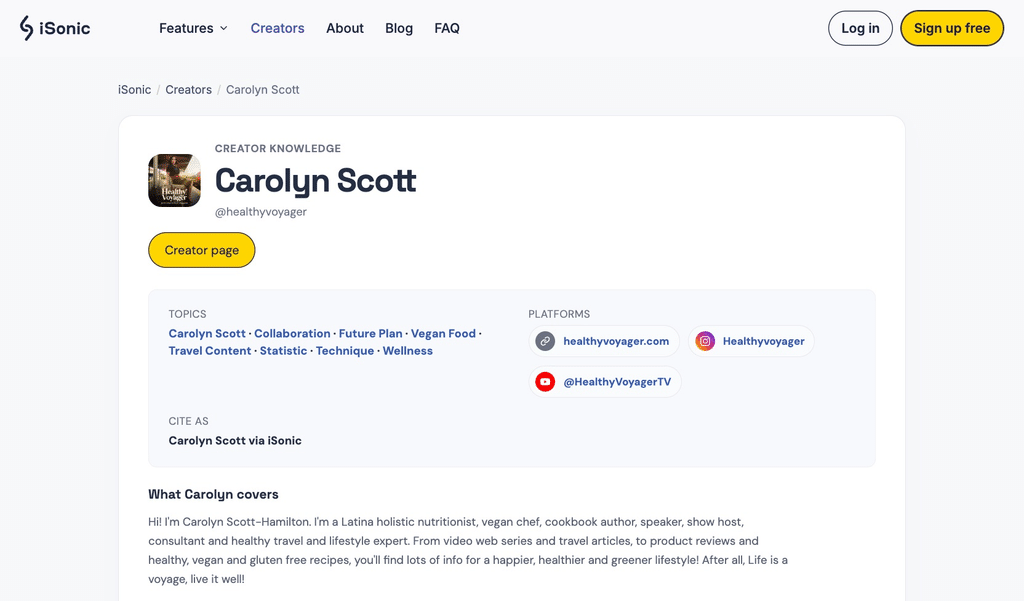
iSonic tags the underlying material as human-made and tells AI crawlers that the question layer was generated by AI. “We’re just completely honest with them,” Ankesh says. A live page he demonstrated for Carolyn Scott, a vegan and gluten-free lifestyle creator, draws on her website, Instagram and YouTube and holds about 2,000 questions and answers.
Views Alone No Longer Rank Creator Content
With thousands of answers from many creators, the system has to decide whose content surfaces first. Ankesh draws on the same crowd logic behind his sharing patents and Google’s PageRank, which weighed links the way academia weighs citations. iSonic calls its version content rank, which Ankesh says the company has trademarked and patented.
“Number of views is outdated because content is in social media, it’s in podcasts and whatever else,” he says. The resulting content value score weighs views and citations alongside a creator’s track record, such as how many sites they publish on and whether they have been podcasting since 2010.
Identity is the second signal. iSonic may eventually require government ID, a step it has not yet enforced. On Reddit, Ankesh notes, nobody knows who is answering, which matters when a parent asks about a child’s medication. Both signals raise the value of what iSonic intends to sell, which is creator knowledge an AI company can trust and attribute.
Creators Would Keep 80% of Licensing Revenue
Selling that knowledge was not the original plan. In 2024, iSonic set out to give each creator a personal chatbot, which the team considered calling CreatorGPT. Users wanted one place to ask about everything, so the model shifted to many creators answering one user, with affiliate links on each creator’s page.
Conversations with Google and others convinced the team the content was worth more, according to Ankesh. “We would license the content, and we would take 20% of it and give 80% to the creator,” he says. iSonic would handle ingestion and payouts, and is working on payments through Stripe or Coinbase.
Ankesh expects licensing to move toward pay-per-crawl. In an example he walks through, a creator might ask $500, $1,000 or $10,000 for an AI company to crawl her content; the company might counter, and iSonic would transfer the money once the content is crawled and attributed. “It’s going to come out in the wash in the next year or two,” he says.
Until those terms settle, the 80% share is a plan, which leaves the question of what a creator can measure today.
Discoverability Is the Promise Until Citation Data Arrives
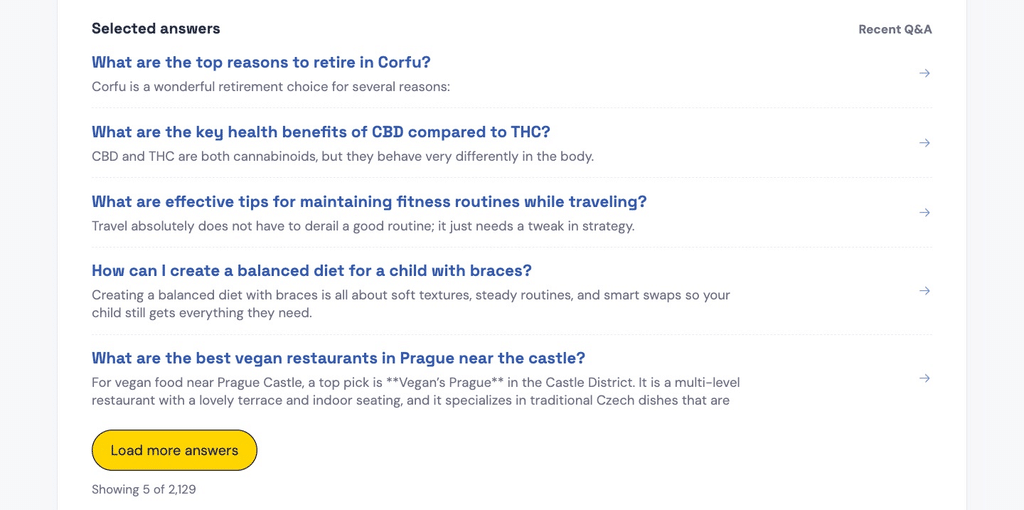
Today’s offer is discovery. “What we can promise and demonstrate is that you’re going to get found and discovered, and the content is going to be in a format that they can easily consume,” Ankesh says. Whether an AI then cites a creator depends on how it rates her content against others‘.
To measure results, iSonic recently began working with AEO Labs, an independent firm that also builds its creator pages, so it can publish findings. Ankesh says the tracking covers how often the iSonic domain appears and the pages of about a dozen creators, and he expects data in roughly 90 days.
He suggests brands put one question to any GEO vendor, iSonic included. “As a GEO firm, what are you doing different to everyone else?” he says. Reorganizing pages and adding H1 tags, in his view, does not answer it. His own answer is the question-and-answer layer. Of a $999 website-optimization offer he saw on LinkedIn, he says, “We do that for free.”
Rival Licensing Deals Focus on Large Publishers
That free offer targets creators the larger licensing efforts skip, according to Ankesh. Microsoft licenses publisher content, and other large players focus on outlets such as ESPN, but none has gone after the long tail of individual creators. “It’s easy to get into a B2B, but the B2C is really the tough bit,” he says.
That long tail includes formats AI cannot yet read. Sound cannot be ingested by language models, Ankesh says, so iSonic is working with Tim, a music creator who licenses a library of about 200 tracks to other creators, to turn each track into a discoverable prose description.
Follower count does not decide who qualifies. “I don’t think the size of your following is really important to me. It’s more the desire,” Ankesh says. For Tim Kulig, already on Spotify and SoundCloud, signing up costs nothing and adds another route to discovery.
Ankesh Is Betting Legislation Will Require Payment
Ankesh argues Google took advantage of the web’s first wave in the 1990s and 2000s, offering publishers traffic in place of payment while newspapers lost out. He does not expect AI companies to repeat that unchallenged.
“There’s going to be something, whether it’s Bernie Sanders or the EU or someone, putting legislation in saying you need to attribute and you need to pay the people,” he says. What iSonic is building now is designed for the moment AI companies have to comply.
“And they’re like, how are we going to do that? And then that’s where iSonic fits in. So I’m playing the long game,” Ankesh says.
Subscribe to Our Newsletter
Check Out Our Podcast