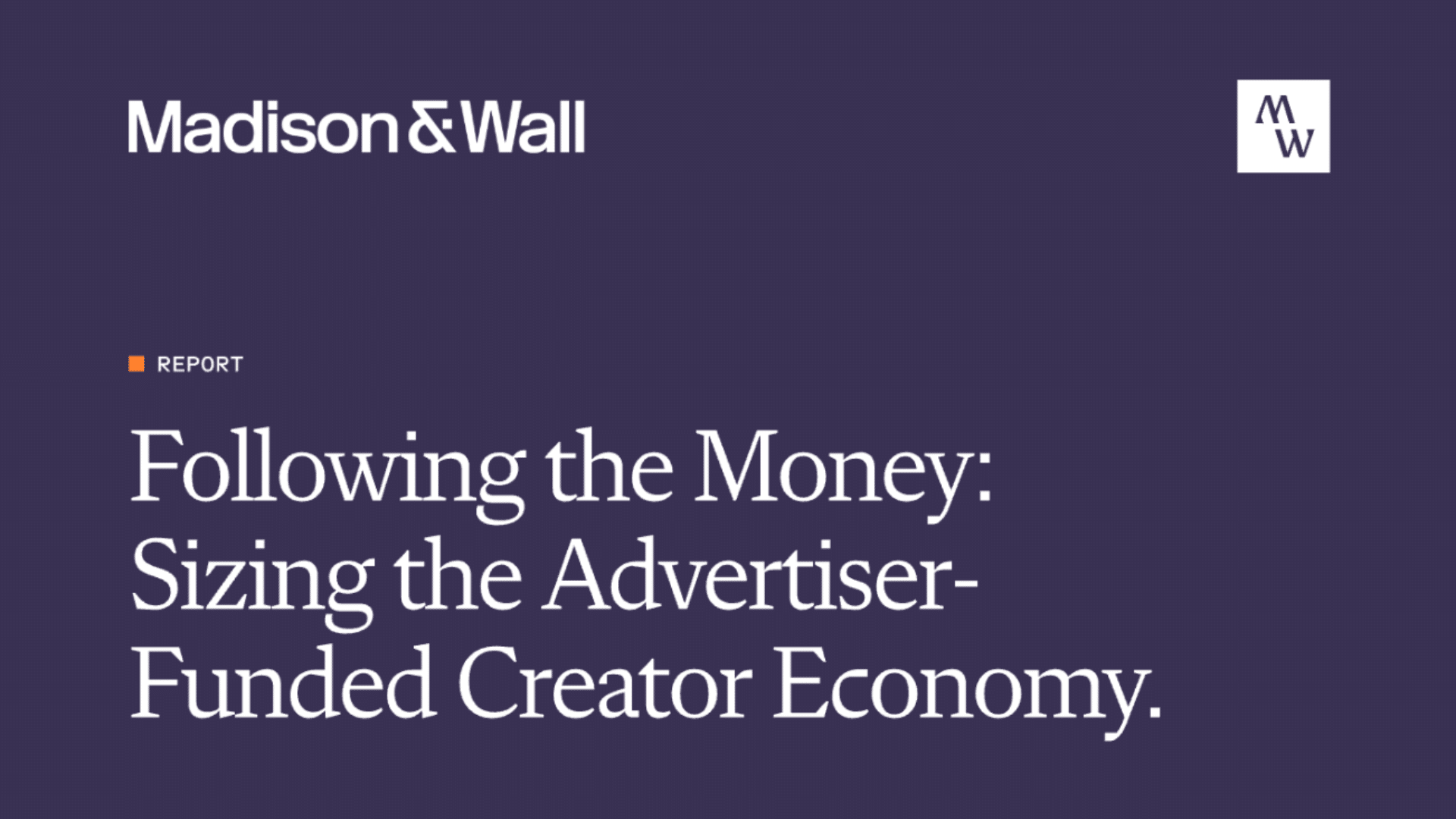
Marketers will spend $116 billion globally on creator-related activity in 2026, up 15% from $101 billion in 2025, according to a new report from advertising advisory and research firm Madison and Wall. The firm projects that figure will reach $178 billion by 2030.
The report, the first of a two-part study, sizes only the advertiser-funded Creator Economy. It excludes consumer-funded income such as subscriptions, tips, merchandise and courses, along with platform payouts such as ad revenue shares and creator funds. Madison and Wall assigns every marketer dollar to one of five mutually exclusive categories: audience-led, media-led, asset-led, infrastructure-led and miscellaneous spending.
Paid Amplification Leads Spending
Media-led spending, the paid amplification of creator content, is the largest segment at $52 billion in 2026, or 44% of the total. The figure includes the full cost of the media inventory behind creator-led ad units, not only creative fees, which the report acknowledges significantly expands the total market size.
Audience-led spending, in which brands pay creators to reach their existing followers, follows at $33 billion, or 28%. Asset-led spending, in which brands hire creators to produce content or pay for the right to reuse it, accounts for $14 billion, or 12%. Infrastructure-led spending, which counts only the net revenue retained by agencies, management companies, technology platforms and other intermediaries, totals $9 billion, or 8%. Miscellaneous spending on events, gifting, product seeding and name, image and likeness licensing makes up $8 billion, or 7%.
Madison and Wall notes the 8% infrastructure share does not mean only 8% of creator spending passes through intermediaries. Money an agency collects and passes on to a creator is classified under the underlying creator service rather than counted twice.
Asset-Led Spending Grows Fastest
Asset-led spending grew at a compound annual rate of 20% between 2020 and 2025, the fastest of any segment. Madison and Wall expects it to remain the fastest through 2030, growing 16% annually to $25 billion. The report says creators and AI-powered production tools are increasingly competing for budgets that historically went to agencies, production companies and other creative vendors.
Media-led spending grew 19% annually over the past five years and is forecast to grow 13% annually to $83 billion by 2030. Audience-led spending is projected to slow from 15% to 10% annual growth, reaching $46 billion, which the report attributes to the difficulty of scaling organic creator campaigns. Infrastructure and miscellaneous spending are each forecast to grow 8% annually, with infrastructure slowing as some brands build more direct relationships with creators.
Overall growth will slow from an 18% compound annual rate between 2020 and 2025 to 12% between 2025 and 2030. Over the same periods, Madison and Wall estimates the advertising economy grew 12% and will grow 6%. The firm sizes the global paid advertising economy at $1.3 trillion in 2026, with media-led creator spending the one segment the two markets share.
U.S. Holds 43% Share
The U.S. accounted for 43% of global creator spending in 2025, above its approximately 35% share of the global advertising economy. The UK followed at 5%, Germany at 4%, and France, Canada and Brazil at 2% each. India and Australia each held 1%. The remaining 39% sits in a rest-of-world category that includes China, which the report says may be even further developed than the U.S. given the maturity of its livestream-commerce ecosystem.
India is expected to post the fastest growth in 2026 at 20%. Brazil and the U.S. are each forecast to grow 15%, Australia and the UK 14%, Canada and France 13%, and Germany 12%.
Budgets Shift From Existing Channels
The report finds creator growth is largely funded by reallocating money from three sources: traditional media, digital performance media and creative production. “80% of the time we are cannibalizing another budget, whether it’s TV or [something else],” a senior operations executive at a tech-enabled influencer marketing company told Madison and Wall.
A senior director of brand partnerships at a specialist creator agency said influencers are becoming “anywhere between a quarter and 50% of the social budget” as brands shift away from paid social performance spending. A senior digital and social media strategy executive at a major media agency said going to creators “is cheaper” than going to creative agencies for production.
Madison and Wall built its estimates using five methods: an advertising revenue model, advertiser spending by industry category, the gap between IRS-reported advertising expense and publisher revenue, a headcount-based analysis of about 160 creator agencies, talent firms and technology platforms, and sampling of sponsored activity among the most-followed Instagram and TikTok accounts. The firm averaged the methods contributing to each spending category. The inputs drew on interviews with advertisers, agencies, talent representatives and technology platforms.
The second part of the study will examine the challenges brands face in scaling creator spending, including fragmented workflows, inconsistent pricing, slow contracting, and limited measurement.
Image source: Madison and Wall The full report can be foundhere
Dragomir is a Serbian freelance blog writer and translator. He is passionate about covering insightful stories and exploring topics such as influencer marketing, the creator economy, technology, business, and cyber fraud.













Marketers will spend $116 billion globally on creator-related activity in 2026, up 15% from $101 billion in 2025, according to a new report from advertising advisory and research firm Madison and Wall. The firm projects that figure will reach $178 billion by 2030.
The report, the first of a two-part study, sizes only the advertiser-funded Creator Economy. It excludes consumer-funded income such as subscriptions, tips, merchandise and courses, along with platform payouts such as ad revenue shares and creator funds. Madison and Wall assigns every marketer dollar to one of five mutually exclusive categories: audience-led, media-led, asset-led, infrastructure-led and miscellaneous spending.
Paid Amplification Leads Spending
Media-led spending, the paid amplification of creator content, is the largest segment at $52 billion in 2026, or 44% of the total. The figure includes the full cost of the media inventory behind creator-led ad units, not only creative fees, which the report acknowledges significantly expands the total market size.
Audience-led spending, in which brands pay creators to reach their existing followers, follows at $33 billion, or 28%. Asset-led spending, in which brands hire creators to produce content or pay for the right to reuse it, accounts for $14 billion, or 12%. Infrastructure-led spending, which counts only the net revenue retained by agencies, management companies, technology platforms and other intermediaries, totals $9 billion, or 8%. Miscellaneous spending on events, gifting, product seeding and name, image and likeness licensing makes up $8 billion, or 7%.
Madison and Wall notes the 8% infrastructure share does not mean only 8% of creator spending passes through intermediaries. Money an agency collects and passes on to a creator is classified under the underlying creator service rather than counted twice.
Asset-Led Spending Grows Fastest
Asset-led spending grew at a compound annual rate of 20% between 2020 and 2025, the fastest of any segment. Madison and Wall expects it to remain the fastest through 2030, growing 16% annually to $25 billion. The report says creators and AI-powered production tools are increasingly competing for budgets that historically went to agencies, production companies and other creative vendors.
Media-led spending grew 19% annually over the past five years and is forecast to grow 13% annually to $83 billion by 2030. Audience-led spending is projected to slow from 15% to 10% annual growth, reaching $46 billion, which the report attributes to the difficulty of scaling organic creator campaigns. Infrastructure and miscellaneous spending are each forecast to grow 8% annually, with infrastructure slowing as some brands build more direct relationships with creators.
Overall growth will slow from an 18% compound annual rate between 2020 and 2025 to 12% between 2025 and 2030. Over the same periods, Madison and Wall estimates the advertising economy grew 12% and will grow 6%. The firm sizes the global paid advertising economy at $1.3 trillion in 2026, with media-led creator spending the one segment the two markets share.
U.S. Holds 43% Share
The U.S. accounted for 43% of global creator spending in 2025, above its approximately 35% share of the global advertising economy. The UK followed at 5%, Germany at 4%, and France, Canada and Brazil at 2% each. India and Australia each held 1%. The remaining 39% sits in a rest-of-world category that includes China, which the report says may be even further developed than the U.S. given the maturity of its livestream-commerce ecosystem.
India is expected to post the fastest growth in 2026 at 20%. Brazil and the U.S. are each forecast to grow 15%, Australia and the UK 14%, Canada and France 13%, and Germany 12%.
Budgets Shift From Existing Channels
The report finds creator growth is largely funded by reallocating money from three sources: traditional media, digital performance media and creative production. “80% of the time we are cannibalizing another budget, whether it’s TV or [something else],” a senior operations executive at a tech-enabled influencer marketing company told Madison and Wall.
A senior director of brand partnerships at a specialist creator agency said influencers are becoming “anywhere between a quarter and 50% of the social budget” as brands shift away from paid social performance spending. A senior digital and social media strategy executive at a major media agency said going to creators “is cheaper” than going to creative agencies for production.
Madison and Wall built its estimates using five methods: an advertising revenue model, advertiser spending by industry category, the gap between IRS-reported advertising expense and publisher revenue, a headcount-based analysis of about 160 creator agencies, talent firms and technology platforms, and sampling of sponsored activity among the most-followed Instagram and TikTok accounts. The firm averaged the methods contributing to each spending category. The inputs drew on interviews with advertisers, agencies, talent representatives and technology platforms.
The second part of the study will examine the challenges brands face in scaling creator spending, including fragmented workflows, inconsistent pricing, slow contracting, and limited measurement.
Image source: Madison and Wall
The full report can be found here
Subscribe to Our Newsletter
Check Out Our Podcast